A small seaweed excursion in Galway

On Tuesday afternoon, we decided to take a walk along the Galway coast down to a pier leading out to a small island, where the city’s garbage treatment facility is located. We had heard rumours that there would be seaweed.
We were also told to nip into the building next to the Conference, where the Galway macroalgae research group works. We were totally awestruck when we came into the entrance and saw that this is the actual physical location of AlgaeBase. After the first shock we found the elevator and went up. Three surprised researchers looked up from their lunch. “You are looking for Mike” they concluded. “Aaahh nooo …” we replied and realized that they were already about to knock on Mike Guiry’s door (big grey door). Thankfully he was not inside (what would we have said to him?) so they showed us on a map where to best access the sea shore and find algae in the area. Thank you very much, it was most helpful!
After this near-celebrity experience we plodded on down to the hotel, changed into more suitable clothes and off we went.

There is something special about the sea air. It is richer in some way. As if it is thick with salt and sea. We came down to the pier and immediately saw that there was much seaweed! And blackberries! After a small snack we climbed down on the rocks and started picking seaweed and seashells. Nowadays, the limpet Patella vulgata is classified as extinct in Sweden. It used to be transported in currents to the Swedish west coast as larva and then grow up there but it never actually propagated in Sweden. Now, the currents have changed a bit and the larvae are not replenished anymore. Those that once existed has died out, so it’s been a long time since I found some limpet shells. Here, there were several! There were also large fine yellow shell of periwinkle Littorina obtusata (or fabalis …) who also went into my pocket.

But now for the seaweed. I briskly took off my socks and shoes, rolled up my pants and waded out a few feet to pick up a stone toped with Pelvetia caniculata, which I had not seen live before. New species! We also found lots of Ascophyllum nodosum which was much bigger and broader than at home. That’s Atlantic water for you! Here, the salinity is 35 psu, on the Swedish west coast is only around 28 psu.

My first Pelvetia caniculata

My first Pelvetia caniculata

The bladderwrack was beautiful, floating in huge, blow-rich drifts. How can you choose just a few pieces, when you want to take the whole bag full? Here, the bladders are not only one pair of bladders per year , but it really does live up to its name vesiculosus with repeated bladders along the branches. Amazing!

Bladder rich bladderwrack

Bladder rich bladderwrack

But, why are my shoes almost standing in the water? I left them on the top of the …. oh oh oh tidvatnet coming in at high speed! On with the socks and shoes quickly and onto the pier again! Whew, you’re not accustomed to such fluctuations when working in the Baltic Sea. We trudged back to the hotel again to put the seaweed in the press and wash the salt from the shells before we return to the conference.

Weed trip in Galway

Weed trip in Galway

It’s….the 48th European Marine Biology Symposium!

This year’s edition of the EMBS, the 48th, will be held in the charming city of Galway on Ireland’s west coast.
During the week, you, dear BalticSeaWeed blog reader,will be able to keep up with the events, which we do our best to serve piping hot.

The programme is full of interesting presentations and posters. New for this year is the possibility to also present posters with a video on YouTube in order to really reach out with the results. We think that’s a brilliant idea, since Poster sessions are often a bit crowded and bustling, where long explanations and discussions can be difficult.
We also note that both Finnish and Estonian colleagues will contribute with interesting seaweed-talk.

Naturally, we hope to take a stroll along the beach to collect some seaweed for the herbarium. We have already found the seaweed products in stores.

The big question is which team will take home the Yellow Submarine this year. Don’t miss out on this!

Field season in full bloom

The days are just soaring by as the field season hits its high peak.

Helping us in this organized chaos is Frances Ratcliffe, volonteering marine biology student from UK. It’s such a help to have an extra pair of hands. We are very glad to have her with us.

Frances and bladderwrack!

Frances and bladderwrack!

The week before last was spent at the Askö laboratory, were we ran the Baltic Sea part of a two-station experiment wich will look closer on the effects of grazing snails on seaweed.

First, we put the seaweed (Fucus vesiculosus and Fucus radicans) grow a while without any grazers, in order to get undamaged tissue.

Seaweed growing

Seaweed growing

After a couple of weeks, we placed the tips in jars with gastropods (marine snails) and let them graze for a couple of days. We so hope that they were hugry and ate a lot, so that we can see the grazing damage under the microscope later on.

45 jars with gastropods and an even flow of water. Amazing what you can build with a pipe and some hose.

45 jars with gastropods and an even flow of water. Amazing what you can build with a pipe and some hose.

Once the seaweed was grazed, we collected some Ulva intestinalis, a green algae, and made it release its spores.

<img src="http://tangbloggen.files.wordpress.com/2013/07/entero1.jpg?w=300" alt="Ulva intestinalis spores makes the water go green.” width=”300″ height=”224″ class=”size-medium wp-image-910″ /> Ulva intestinalis spores makes the water go green.

What we hope to see is if the spores will be able to grow on the grazed surface of the seaweed.

<img src="http://tangbloggen.files.wordpress.com/2013/07/sdd201.jpg?w=300" alt="We have seeded the grazed seaweed by poruing spores of Ulva intestinalis in the water” width=”300″ height=”224″ class=”size-medium wp-image-920″ /> We have seeded the grazed seaweed by poruing spores of Ulva intestinalis in the water.

Let’s keep our fingers crossed and hope that it grows!

The week that was and this week, is spent at Tjärnö laboratory on the other side of Sweden, were we are running the same experiment, but in saltier water and with Ascophyllum nodosum instead of Fucus radicans and with other gastropods.

Our lives have been made so much easier thanks to Marit, who is doing her master thesis together with us. She has tended to our experiment so that we didn’t have to go back and forth between the coasts like crazy. Thank you Marit!
Meanwhile, she has also done an enormous fieldwork on a very interesting study on gastropods and seaweed, that we hope to write more about here on the BalticSeaWeedBlog.

Marit shows her disected gastropods.

Marit shows her disected gastropods.

it is always nice to meet and talk about seaweed. We had many nice discussions on this fascinating topic.

Frances, Marit and Lena discuss seaweed at Tjärnö Laboratory.

Frances, Marit and Lena discuss seaweed at Tjärnö Laboratory.

Gold medal to professor Lena Kautsky

Vice-chancellor of the University of Stockholm has decided to distribute the Stockholm University gold medal of the 8th size in ribbon to three persons who in various ways have promoted the University’s activities.

One of these is the BalticSeaWeed blog’s very own Professor Lena Kautsky.

The motivation reads as follows:
“Lena Kautsky, professor of marine ecological botany, is awarded Stockholm University gold medal of size 8 in ribbon for her deep involvement in marine research and education at Stockholm University, in national collaboration on marine environmental issues and sharing of knowledge to the public and decision makers. Her leadership of the Stockholm Marine Research Centre and Asko Laboratory has been a decisive part in the fundamental work resulting in Stockholm University’s new Baltic Sea Centre. ”

The medals will be awarded at the installation ceremony held at City Hall on September 27th.

The BalticSeaWeed blog, swelling with pride, will of course post pictures from the ceremony.

See also university’s website (in Swedish only).

Seaweed course in Denmark

The week has been spent in Denmark, on a full Sunday to Sunday course to learn more about macroalgae.
With a schedule so full you can hardly fit it to a paper, the hopes and expectations to become a real seaweed guru are high.
There are 11 PhD students partaking, all from different countries!
The course is arranged by Aarhus University, as you can see in their newsletter (sorry, only in Danish).

Our first day of the course, we went out to collect macroalgae in the field. We started at the pier next to Ebeltoft harbour, where the sun shone and it was lee on the inside where we were working. I took this years “first swim without a drysuit in Nordic waters”. It was a refreshing 16 degrees Celsius and I was in the water for about 10 minutes, collecting material. Here there were four Fucus species growing: Fucus spiralis, Fucus vesiculosus, Fucus evanescens and Fucus serratus. Jackpot!

Lots of seaweed!

Lots of seaweed!

After a field lunch of sandwiches, we headed north, to Grenaa. Here, the Marine Home Guard and their boat took us out on Kattegat! What a luxury! This is a new collaboration between the Home Guard and Aarhus University, so the Danish TV was out and filmed us. Click here and fast forward to 1:19 into the clip and there we are.

Monday evening and Tuesday was spent going through the collected material to determine the different species and look at their different physiological structures.
On Wednesday, we tried to reproduce sugar kelp ( Saccharina latissima ) by getting them to release spores. It didn’t quite go as planned, so we took some good old bladderwrack and got it to release eggs and sperm instead.

On Thursday, we went to Algcenter Grenaa and had a look around. Pictures from our visit you can see the Algcenter website

Anette Bruhn show us how they cultivate sugarkelp at the Algcenter

Anette Bruhn show us how they cultivate sugarkelp at the Algcenter

We also got to visit the Kattegat Center, located just across the parking lot. This is one of Denmark’s many fine aquariums that have long been on my wish-to-see list. It was just as good, if not better, as I had expected. There was even an exhibition of algae and their importance. It is totally worth a visit!

Friday and Saturday were devoted to compiling and analyzing all of our data, and then present it in four groups according to various themes (Taxonomy, Monitoring, Light and Cultivation).

Danish seaweed; red, brown and grøn

Danish seaweed; red, brown and grøn

Seaweed project within BalticSea 2020

Anyone who is interested in the Baltic Sea might have heard of Baltic Sea 2020 Foundation.
Baltic Sea 2020 is a foundation founded by Bjorn Carlson through a donation of 500 million SEK (55 million EUR). The Baltic Sea 2020 Foundation’s assets shouldfund projects that are action-oriented, innovative and helps to improve the knowledge of the Baltic Sea continuously until 2020. The BalticSea 2020 Foundation began its work in 2006 and has to date initiated more than 70 projects, of which 25 are ongoing.

One of these projects is about trying to re-establish bladderwrack inside Björnöfjärden, a bay outside Stockholm. Björnöfjärden is heavily eutrophicated and the water is quite turbid with particles that prevents the light from penetrating. It quickly becomes dark below the surface, so that only a few stands of seaweed survive here. Observant locals have informed us that there was plenty of seaweed in the Björnöfjärd in the past, however.

So, seaweed enthusiasts to the rescue!

Susanne Qvarfordt is ready to establish bladderwrack.

Susanne Qvarfordt is ready to establish bladderwrack.

Susanne Qvarfordt from the environment surveillance company Sveriges Vattenekologer has initiated a project that will examine what factors might prevent the seaweed population from re-establishing in Björnöfjärden.
In addition, she asked the BalticSeaWeed blog to help with our expertise!

So, during the first days of June, we collected fertile tips of bladderwrack. These were sexed (we cut the receptacles and see if they are male or female), so that we would get an appropriate ratio of males and females at each site.

Sexing seaweed is best done with a scalpell and a magnifying glass.

Sexing seaweed is best done with a scalpell and a magnifying glass.

The bladderwrack were made into small beautiful fertile bouquets which were then attached to a grid. These will be placed in the water, floating over a number of concrete plates, and hopefully make new small seaweed babies that can attach itself to the plates.

All is ready for a baby boom!

All is ready for a baby boom!

So, now we have placed three grids in Björnöfjärden and three in nearby Fjällsviks Bay, to see if any of the other actions carried out in Björnöfjärden will affect the seaweeds ability to reproduce.
So, keep your fingers crossed that no one gets caught with their anchor or fish tackle in our beautiful grids, and hope for calm weather at Midsummer full moon so that there will be many wee ones.

Placing a seaweed grid with buoys.

Placing a seaweed grid with buoys.

Around Gotland

Yessiree! It’s time to jump into the water again!

After a long winter with lots of ice, and a well deserved trip to warmer water, it was time for yours truly to submerge oneself into the cool waters of the Baltic Sea.

Field season 2013 opened on Wednesday 22 May at the scenic island of Gotland, jewel of the Baltic Sea.

For the faithful reader, it comes as no surprise that it was time for the inventory of summer reproducing bladderwrack around this beautiful island, as part of the investigation we made along the mainland coast and Gotland last year (see previous post on Tångbloggen 2012 – A seaweed odyssey).

Gotland is well known by many botanists for its amazing flora, and the orchids certainly fought for space with primroses and lily of the valley along the road as we drove north from Visby up towards our first stop just south of Lickershamn.

Orchis mascula- Early purple orchid

Orchis mascula- Early purple orchid

Unfortunately, I think most people fail to see how beautiful Gotland is below the surface. The clear water and the dense seaweed forests are magically beautiful and are conveniently found at knee-depth in the water. If you do not like to get wet, you can easily experience life below the surface with a pair of high rubber boots or waders and water binoculars.

Our second stop was out on the island Fårö, at Lauter huvud. At the moment it’s a rather low water level in the Baltic Sea. It is caused by the weather and is not unusual this time of year. But it gets a little tricky to swim when you are constantly running aground. It was easier to walk among the rauks and occasionally stick my head under the surface in order to verify single specimens of Fucus. Quite possibly the occasional tourist who stayed at the car park was wondering what we were doing. One is not exactly discreet in a bright red dry suit. Hope I did not destroy too many photographs by emerging between rauks like a jack-in-the-box.

Having swum a little off the cliff edge, where it goes from 0.5 meters deep to 15 meters, we went to today’s third and last site at Östergarn.

Here the waves rolled in with a quiet rhythm, and if I had not been busy counting, I would certainly have fallen asleep, it was so very peaceful. The sun had come out and warmed my back as I floated about. I saw plaice, viviparous eelpout (Zooarces viviparus), stickleback, and Lesser pipefish (Syngnathus rostellatus).

Plattfisken vilar bland tången.

The plaice is resting among the seaweed.

The night was spent at the nice hostel in Hemsedal, which had very comfortable beds.

Thursday morning began with a trip down to the southernmost tip of Gotland, the Hoburg. Here we encountered more nature lovers in the form of a flock of birdwatchers. The species often nests at the southern tips of both Oland and Gotland and is easily recognized by the telescope that is often worn over the shoulder.

I even saw Red-Backed Shrike (Lanius collurio), Northern Wheatear (Oenanthe oenanthe) and a yellow bird that I didn’t recognize.

The sea was calm and the swans that landed some distance away did not attack the red ball splashing around, muttering through a tube (snorkel). It was nice to see that htere were many small juvenile seaweed individuals there. Reproduction last year was apparently very successful. Always a good sign.

Our last stop for a dip was just south of Klintehamn. On the way there we visited the nice naturum center in Vamlingbo for a short break. With coffee in the body, we parked at what must be Gotland’s busiest road, and changed into work clothes.

“When you take off your pants, five cars and a bus will always appear” – Old jungle proverb

It was the only site with lots of bladders on the wrack! One might think that bladderwrack always have bladders, but no! If the site is exposed to strong wave action, no bladders are formed. This is to minimize wave grip, so that the wrack does not get torn off by the waves.

Blåsor på blåstången - inte en självklarhet.

Bladders on the bladderwrack – not always to be expected.

It was plenty of gammarids, prawns and isopods here, and I hope I got a picture of the Lesser Pipefish hiding amongst the seaweed. It was obvious that there is a lot of nutrients coming out into the water as runnof from land. The seaweed had much filamentous algae growing on them. Swimming across it reminded me of a shaggy rug.

After again having fulfilled the jungle proverb (Why?!?) we headed towards Visby and enrolled into the prison. If we get out tomorrow remains to be seen.

Dissertation time for thesis on Fucus radicans and Fucus vesiculosus

Friday 17th of May is not only the National Day of Norway to be celebrated, but also the doctoral defence of Daniel Johansson.
Daniel has studied at the Sven Loven Centre for Marine Sciences Tjärnö (more commonly known as TMBL) belonging to the University of Gothenburg.

Daniel’s thesis is entitled “Evolution of the brown algae Fucus radicans and Fucus vesiculosus in the Baltic Sea” and contains primarily work from a genetic point of view. There has been a lot of work put into obtaining the genetic identity of both species in order to distinguish Fucus radicans from Fucus vesiculosus, but also to be able to distinguish between different clones of Fucus radicans, which in the Gulf of Bothnia reproduces mostly vegetatively. This is achived by proliferation, small branches that fall off from the parent plant and then attach themselves to new substrate.

Small branches of Fucus radicans have formed rhizoids (sticky threads) that attach to the Petri dish.

Small branches of Fucus radicans have formed rhizoids (sticky threads) that attach to the Petri dish.

Daniel has also compared the ability of proliferation between different clones of Fucus radicans to see if the dominant clone, a female that has been found along 550 km of the Swedish Coast, was better than the other clones.

The defense starts at 14:00 in the Auditorium at Tjärnö, of course we will be there to listen!

International Seaweed Symposium – Day 4

With rested brains, it is once more time to stock up on more seaweed, both mentally and physically.

All things sweet and seaweedy

All things sweet and seaweedy

After an opening plenary lecture by Iain Neish about the importance of having a vision and being stubborn if we are to succeed with aquaculture, it was time for a cup of coffee, a slice of fruit cake and the day’s first mini-symposium.

Plenary with Iain Neish

Plenary lecture with Iain Neish


Mini Symposium: Cultivation of tropical red seaweeds

The most common species of red seaweed that are farmed are Eucheuma spp., Kappaphycus spp., Porphyra spp. and Gracillaria spp.
In Chile and Peru, it is primarily Gracillaria spp. that is farmed. In Chile, they seek to develop new methods to cultivate seaweed in the lab, instead of taking material from wild populations as many do today. They have also investigated whether it is possible to grow other commercial species.

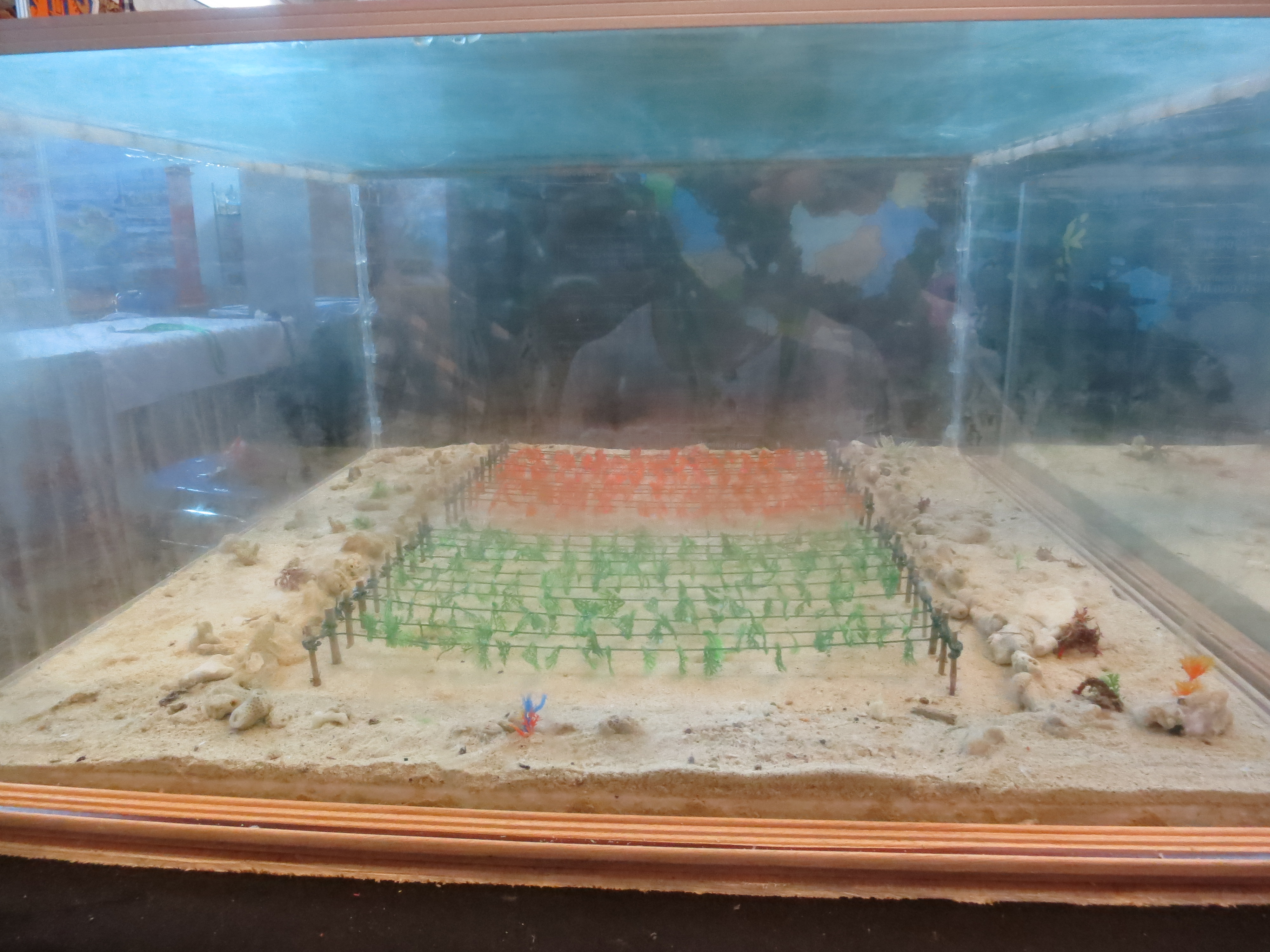
In Malaysia, the Philippines and Indonesia, most seaweed is farmed using the fixed off-bottom technique in shallow waters. The trick is to place them deep enough so that the algae are not harmed by the intense sun during low tide.

Most algae in shallow waters are farmed using the off-bottom method.

Most algae in shallow waters are farmed using the off-bottom method.

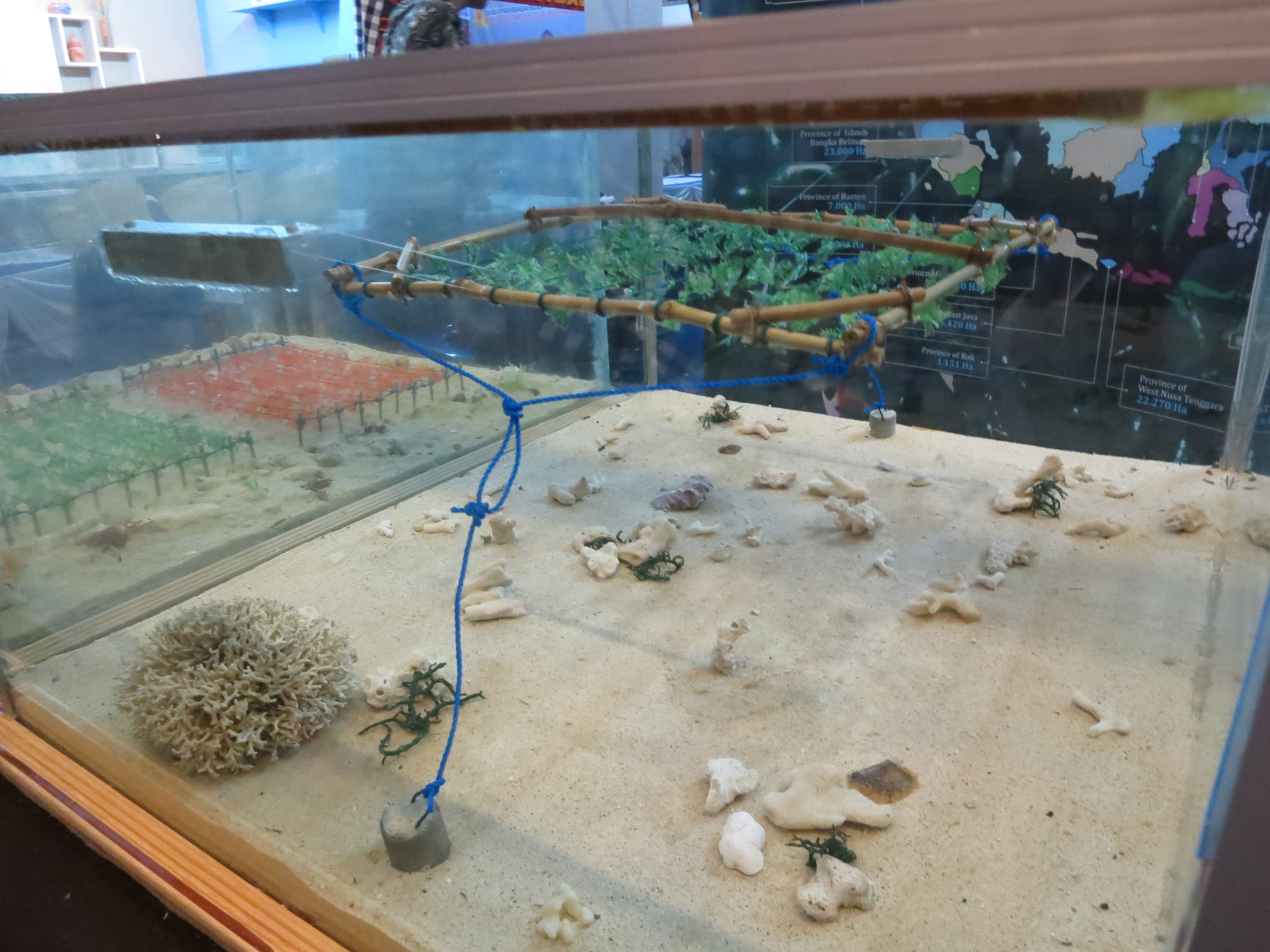
In deeper water, they use the free-swing method, where only one end is fixed at the bottom. The downside is that it takes up quite a lot of space, and then they must be set at such a distance that they do not become entangled in each other.

The free swing method, attached at only one point.

The free swing method, attached at only one point.

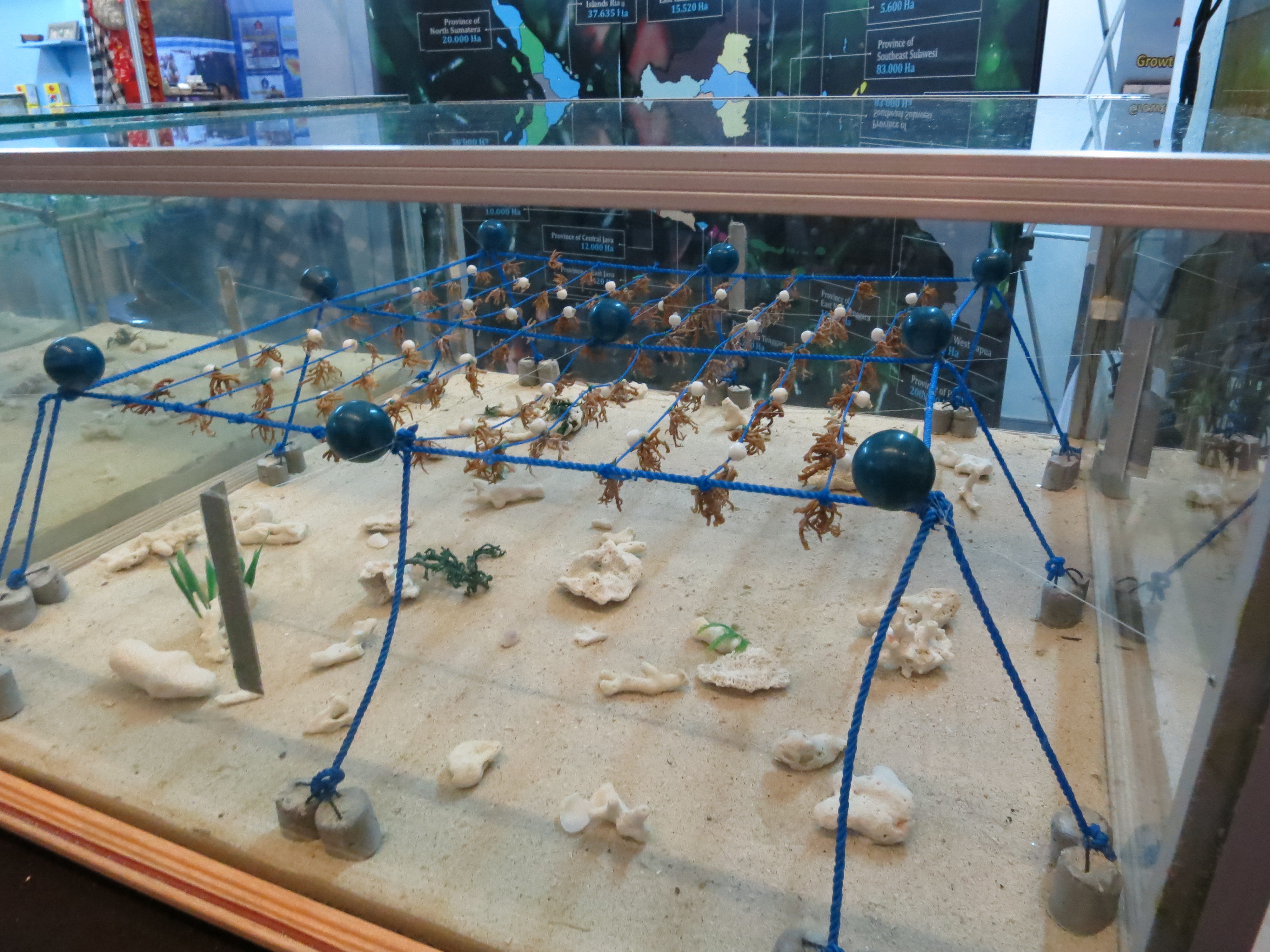
Other methods for deeper water is something called single longline rafts, spider web rafts or floating triangle, depending on how you have designed the ropes. But these rafts are secured at all four corners and thus are more stationary. It also means that you can place them closer together, without risking entanglement.

In deeper waters, single longline rafts are common.

In deeper waters, single longline rafts are common.

Some growers use hanging baskets that the seaweed is floating freely in, which does not seem like a good idea to me. But this is still at the development stage. They use high pressure water hoses to remove unwanted growth of other seaweed (epiphytes).

Dr. Flower Msuya from Tanzania showed a summary of how seaweed cultivation has started and continued for the East African coast, with examples from Mauritius, Madagascar, Tanzania and Zanzibar course. The main problem to cope with is that they are now beginning to get problems with various diseases. There is much further research to do and a lot of mistakes to learn from. At the same time, a mini-symposium was held in the hall next to this, with the topic being diseases and parasites on seaweed. It’s a hot topic for the seaweed industry.

Presentations: Integrated aquaculture and introductions
In Australia, much yellowtail kingfish and tuna are farmed. At present, there is no cultured seaweed in Australia, so the researchers are now trying to find species suitable for cultivation along with fish farms in order to reduce emissions (IMTA, see previous posts). The species they are looking for are those that are good at taking up nitrogen from fish farms, but there should also be a market for the seaweed.

Kathryn Wiltshire from the University of Adelaide tested several species of red and brown seaweed to see which was best at taking up nitrogen and which grew fastest, in order to select species suitable for further experiments with the conditions that give the best performance.

Tom Schils from the University of Guam (you get extra points if you know where it is without looking it up) told us that coral reefs in Micronesia and the Pacific have very distinct algal communities, which are now threatened by introducing new varieties of these species bred for cultivation. A well-known example is the red alga Acanthophra spicifera that has taken over shallow waters on coral reefs around Hawaii.

Micronesia has a Biosecurity Plan, which seeks to identify and prevent threats to the marine environment, such as how to manage ballast water which is a great disseminator of species from one place to another.

Dr. Yang from China showed how the farming of the red alga Gracillaria spp. is along China’s 18,000-kilometer coastline and how China is now working to develop the use of integrated aquaculture. Between 1967-1980, 50-60% of China’s aquaculture consisted of cultured seaweed, mainly brown alga Saccharina japonica. Since then, the proportion of farmed fish, shrimp, crabs and clams increased. It leads to increased nitrogen load, and you need to cultivate more seaweed to not have problems with eutrophication.
The production of Gracillaria spp. is rising steadily, from 0.13 hectares in 2000 to 1,067 hectares in 2007. In 2011, the total cultivation area of Gracillaria was an astonishing 1,500 hectares!