Autumn preparations at Askö Laboratory

Last Monday it was time to put the seaweed out in the sea for overwintering. After some different trials of overwintering indoors in the Experiment Hall at the Askö Laboratory, with extra lights and air pumps, we have found that it is still difficult to get good enough water circulation and movement for the seaweed to be happy. It becomes brittle and falls apart come spring. But tying plants on to net cages and placing them on the sea floor at some meters depth works just fine!
The weather was amazing. Calm and brilliant sun. But the water level was too high, so now they are places too shallow to remain in the bay all winter. We will have to come back later and move them to a deeper waters. That will be a dry suit -job.

Image

In this year’s seaweed plantation is material from Gotland that we have collected in order to try and solve the question of if there is a third ecotype of bladderwrack. We know from before that in the Baltic Sea we find both summer reproducing (end of May-June) and autumn reproducing (end July-October) bladderwrack. But now it seems that we have found a third type, that reproduces more or less constantly throughout the entire season (May-October).

Image

The Sea Environment Seminar of 2013, was held at Vår Gård located in Saltsjöbaden outside Stockholm. In the morning Lena went for a walk alongthe beach and found plenty of free-floating bladderwrack balls, both in the wrack wall on the beach and also floating in the shallow water, rolling around.

Image

According to litterature, these do not reproduce sexually, and we have never seen any reproductive tips on this form of bladderwrack. Naturally, she collected several wrackballs. Since Lena had forgotten to bring a plastic bag (wich is something a true marine biologist always should keep on her/him), she had to go back to the hotel reception and ask for one. Imagine their surprised looks. The day after, Lena went out to ASkö and tied the wrackballs to little ceramic tiles. What we are looking for is if these freee floating forms will become sexual in spring if they have a fixed up and down. Now they are placed in the sea for the winter, and all we can do is wait for the return of sunlight and warmth in spring, when we can dive down and check if there are any reproductive tips on them.

Image

“Science it’s a girl thing”

Sometimes you just don’t believe your own eyes.

The European Commission is running a campaign to get more girls (or women)into science, called “Science: It’s a girl thing”.

The idea is good, THIS VIDEO, however, is not.

Is the general European perception of women that for us, science is about making better makeup?

I’m lost for words. If science is a girl thing, then feeling insulted by this video must be a woman thing.

Please answer the poll and let us know how YOU do science, girl or no girl. WE are not gender biased.

Fucus radicans movie (in Swedish)

Film time!
It’s been a long time since we had any movies posted on the blog.

At the Swedish site havet.nu is a nice movie (5.35 mins) on Fucus radicans. Our esteemed collegue professor Kerstin Johannesson explains why Fucus radicans is so interesting from an evolutionary perspective “Smaltång och drivkraften bakom uppkomsten av nya arter (Fucus radicans and the driving force behind the origin of new species). It is only available in Swedish, with no subtitles, unfortunately.

Day 5 EMBS – The final sprint

It’s not fun to get the presentation slot first out on the morning after the conference dinner. But Katarina from Estonia got a good attendance and gave an interesting presentation on the zebra mussel (Dreissena polymorpha) and its impact on the ecosystem of the heavily eutrophicated Pärnu Bay in southern Estonia.

Maillie Gall from Australia told A story of two sea urchins, in which she compared the population genetics of the two sea urchin species Heliocidaris erythrogramma and Heliocidaris tuberculata to see how far their larvae spreads. She has primarily examined whether the duration of the planktonic larval stage plays a role for the spreading distance. It was very nice to rest those weary eyes on some beautiful pictures of sea urchins and Australian waters.

Jennifer Loxton held one of the conference’s coolest presentations, according to me. She showed how a bryozoan (phylum Bryozoa, it’s an animal) that came into English waters recently from Japan, reproduce like crazy. With movies and beautiful microscope images, we see that most of the currently known bryozoans form one egg bump per individual, where a larva is formed which then swims away and form a new colony. The Japanese moss animal produces up to five bumps, simultaneously! Unbelievable. The animal is red in color and thrives in cold water with high salinity, so we’ll probably not see it at the Swedish coast.

Final speaker of the conference was Paul Somerfield from Plymouth Marine Laboratory, renowned marine biologist and statistician, who talked about how to use statistics and not place too much weight on that which is odd or rare if one wants to describe an overall pattern. The presentation was entitled “Putting the species back into community analysis “. Funny, easy to understand and relevant!

Yellow submarine 2013

We prepared already on Wednesday evening by writing a team-song, in order to score some extra points. Unfortunately, wedid not get any opportunity to sing, but it will probably come other times when seaweed songs will come in handy.

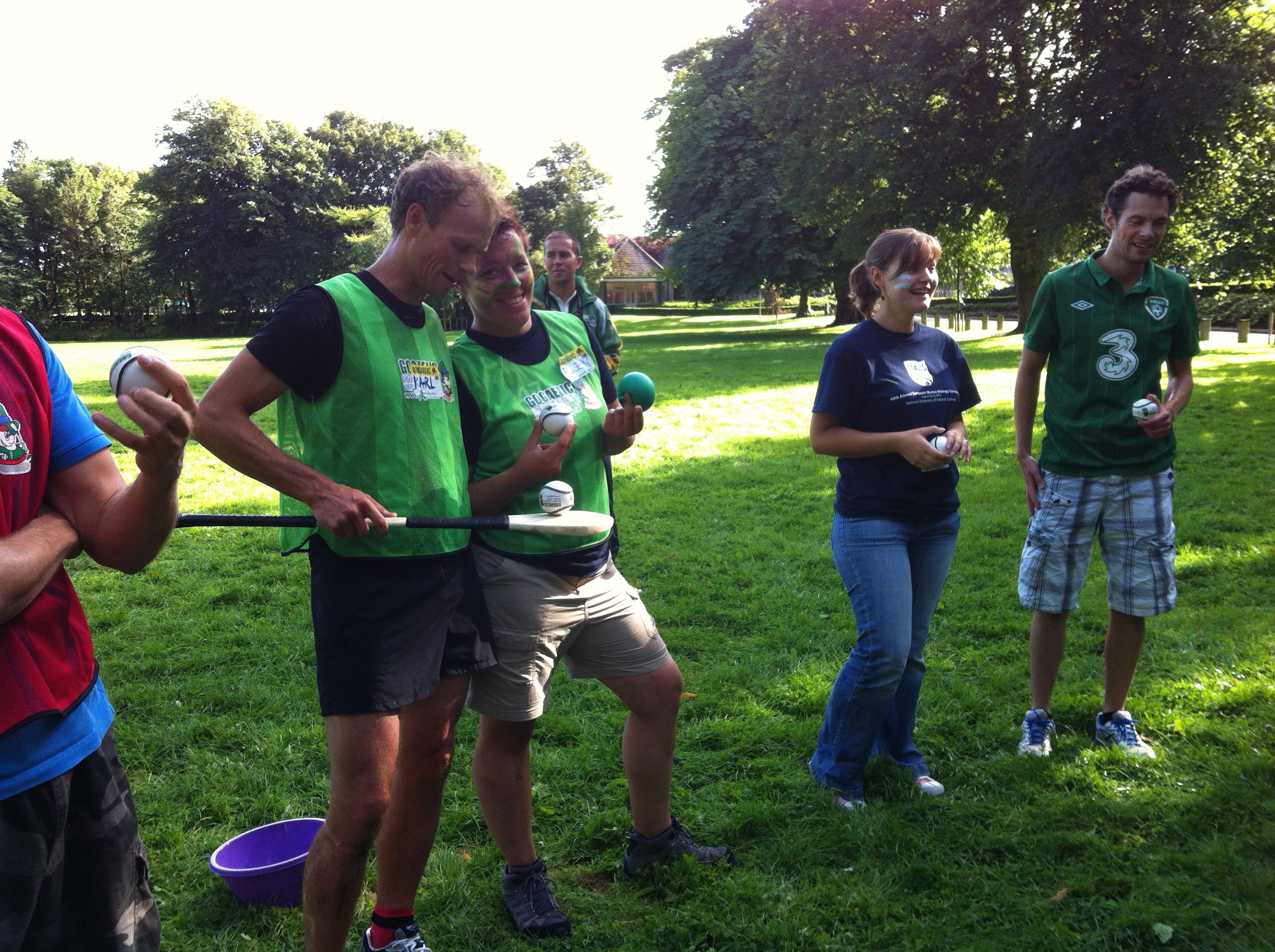
The theme of this year’s competition was gaelic games, which meant training in Irish football (much trickier than the old regular version) and hurley, which is a more violent version of the outdoor hockey …. sort of. You get a stick and a helmet! Fun!

In the first race, each team should balance cups of water on the Hurley stick through an obstacle course, but catastrophic cheating broke out, and developed into outright anarchy, so no points could be awarded. The Swedish-Finnish-Danish-Estonian team, however, had clearly the best technology before the sponge throwing went out of hand.

The final was a dramatic thing, Sweden loosing to Ireland with a hair, litterally. Thankfully there was not too much damage done when two heads were merged into one at high speed. Karl Norling is, as always, a rock.

eftertävlingen

The trophy was awarded later in the evening during the conference dinner under much applause. The evening continued with Irish dancing into the late hours. The BalticSeaWeed blog came home acceptably late and slept well, in order to get to the lectures tomorrow.

Day 4 EMBS Galway

Niall McDonough from European Marine Board started the day. European Marine Board is a partnership of 35 national marine / oceanographic research institutes from 20 European countries. Recently, it has also opened up for a membership of a consortium of universities. The Board is working as a platform to develop a common understanding of what is needed and what should be prioritized within marine research in Europe, and communicate this to policy makers in the EU. There are lots of interesting publications that can be download for free on their website http://www.marineboard.eu
For those who want to learn more about the sea, they are also running a project called Ocean Literacy, wich we will look into more closely and get back to you on.

Brenda Walles from the Netherlands present us with more information about oysters, wich we like a lot, especially with garlic. She has further investigated the possibilities of using oyster beds as erosion protection (bioengineers) on exposed coasts. Today, they are used mostly as breakwaters, but they also have a greater impact on sediment bottoms around them. The most important factor for optimum protection has proven to be the length of the reef, not surprisingly, but the oysters also have more beneficial bioengineering effects that could be utilized better than we do today. And they are so very tasty…

Katrin Bohn from Southampton University has participated in a study of re-colonization of old boat docks in Liverpool that were restored in the early 1980’s. The study was begun several years ago by Professor Stephen J. Hawkins. The restoration wincluded removing large amounts of accumulated sediment in the docks and putting back the gates in order to control the water flow. The water clarity and the oxygen concentration in the dock improved significantly during the first six years, and now mussels, sponges and sea squirts have moved in.

A small seaweed excursion in Galway

On Tuesday afternoon, we decided to take a walk along the Galway coast down to a pier leading out to a small island, where the city’s garbage treatment facility is located. We had heard rumours that there would be seaweed.
We were also told to nip into the building next to the Conference, where the Galway macroalgae research group works. We were totally awestruck when we came into the entrance and saw that this is the actual physical location of AlgaeBase. After the first shock we found the elevator and went up. Three surprised researchers looked up from their lunch. “You are looking for Mike” they concluded. “Aaahh nooo …” we replied and realized that they were already about to knock on Mike Guiry’s door (big grey door). Thankfully he was not inside (what would we have said to him?) so they showed us on a map where to best access the sea shore and find algae in the area. Thank you very much, it was most helpful!
After this near-celebrity experience we plodded on down to the hotel, changed into more suitable clothes and off we went.

There is something special about the sea air. It is richer in some way. As if it is thick with salt and sea. We came down to the pier and immediately saw that there was much seaweed! And blackberries! After a small snack we climbed down on the rocks and started picking seaweed and seashells. Nowadays, the limpet Patella vulgata is classified as extinct in Sweden. It used to be transported in currents to the Swedish west coast as larva and then grow up there but it never actually propagated in Sweden. Now, the currents have changed a bit and the larvae are not replenished anymore. Those that once existed has died out, so it’s been a long time since I found some limpet shells. Here, there were several! There were also large fine yellow shell of periwinkle Littorina obtusata (or fabalis …) who also went into my pocket.

But now for the seaweed. I briskly took off my socks and shoes, rolled up my pants and waded out a few feet to pick up a stone toped with Pelvetia caniculata, which I had not seen live before. New species! We also found lots of Ascophyllum nodosum which was much bigger and broader than at home. That’s Atlantic water for you! Here, the salinity is 35 psu, on the Swedish west coast is only around 28 psu.

My first Pelvetia caniculata

My first Pelvetia caniculata

The bladderwrack was beautiful, floating in huge, blow-rich drifts. How can you choose just a few pieces, when you want to take the whole bag full? Here, the bladders are not only one pair of bladders per year , but it really does live up to its name vesiculosus with repeated bladders along the branches. Amazing!

Bladder rich bladderwrack

Bladder rich bladderwrack

But, why are my shoes almost standing in the water? I left them on the top of the …. oh oh oh tidvatnet coming in at high speed! On with the socks and shoes quickly and onto the pier again! Whew, you’re not accustomed to such fluctuations when working in the Baltic Sea. We trudged back to the hotel again to put the seaweed in the press and wash the salt from the shells before we return to the conference.

Weed trip in Galway

Weed trip in Galway

Day 2 EMBS Galway

After a very pleasant evening with barbecue, beer and talk, most of the conference participants have managed to get out of bed and into the Bailey Allen Hall at the University for the day’s first session on “Mapping habitats and determine the ecological status”. As the title indicates, most of the presentations have a more bureaucratic character.

Opening speaker is Dr. David Connor, a marine biologist with over 30 years of experience in marine monitoring and surveying (including MESH, which maps the Baltic Sea), who is now on a loan to the EU for four years to work with the EU’s Water Framework Directive (WFD).

David shows many of the maps that they are now working on in order to get an overview of Europe’s seabeds. The maps have a resolution of 250x250m per pixel. Imagine that for a terrestrial map…However, it is much more difficult, and expensive, to make detailed maps underwater.
In addition to identifying the type of bottom substrate (sediment, rock, sand) they aim to include biological factors, energy exchanges and much more. The goal is that the European seabeds will be mapped down to 5000 meters depth, with relevant factors and good resolution.

Matt Frost followed with a talk about the benthic habitats and their classification in the EU’s Water Framework Directive, and whether there is such a thing as a sustainable habitat loss and if you can measure it to calculate when it is no longer sustainable. The basis for this work is the EU’s Habitats Directive. The data he shows includes more than one hundred researchers’ work over some years, published in the chapter “Habitat thresholds” in the report State of Seas from 2010.

Matt highlights the problems with getting hold of reliable data from all countries, and the difficulties in collecting good quality data at different depths and in different environments.
He concludes by saying that more research is needed before we can set quantitative targets for habitats, that we need to work out better methods for mapping, and that it is not possible to either set or verify quantitative habitat targets at present.

Dr. Xabier Guinda presents how they have managed to implement the EU’s Water Framework Directive for intertidal and shallow areas in Spain, France and Portugal, and the methods they have used to identify them. Primarily, they have used transects, which is the same as we do in Sweden.

Artem Isachenko presents how they have been able to identify mudflats with the presence of Arctica islandica (Ocean quahog) in the White Sea (where we from the BalticSeaWeed blog are eager to go for collecting some seaweed). To find relevant bottoms with the right type of sediment, they use side-scan sonar in Rugozerskaya strait, and received some very fine maps of bottom topography.

They even managed to interpret the sonar signal to determine the density of the large, very thick shelled Ocean quahog in the sediment, where it lives burrowed. Very convenient and comfortable!

They also checked the calculated numbers by taking pictures of the mudbottoms and count the number of Ocean quahog siphons sticking out of the mud (they are easy to recognize). The study shows that Ocean quahog can live in densities up to 400 individuals per square meter!

Henna Rinne, our Finnish colleague and friend, finish off the habitat mapping theme by presenting data from FINMARINET, which she has worked on for almost ten years. The Project is part of Natura 2000, where they have worked with habitats sandbanks (1110), reefs (1170) and small islands and islets (1620). The numbers are the code of the habitat within Natura 2000.

One of the biggest problems they have encountered when trying to map the coast of Finland is to get data. It exists, but is classified. If they get hold of the data, they are not allowed to publish it. Being from Sweden, we recognize the problem and sympathize. Today when every row boat has an echo sonar and a GPS with better resolution than many charts, one might feel it is no longer necessary to protect the depth data from Charlie (which certainly may find whatever data necessary for an invasion via Google Maps).

After a cup of tea and a stretch of the old legs, it’s time for one of the conference’s two female keynote speakers (a total of 9). Professor Maria Byrne did her bachelor here in Galway, but has since moved to Australia and work with echinoderms.
The presentation is about how the echinoderms entire life cycle, from egg to larva to juvenile and adult, is affected by changes in the aquatic environment. For a species to be able to survive in a changed environment, all stages of the life cycle must be able to be completed. Echinoderms builds up their body with calcium carbonate, so the major threats are ocean acidification (see yesterday’s talk) and increased water temperature.

Two species of sea urchins has clearly been affected. A cold-water species creeps slowly down towards Antarctica and have decreased along the Australian East Coast (Great Barrier Reef), while a temperate species have increased in number and extent as the water has become warmer.

Maria and her research group has investigated whether the response to the stress of increasing temperature and acidification are different, depending on whether the species is a polar water species or from temperate waters. It seems that the polar species are most sensitive to a decrease in pH, whereas species from temperate and tropical waters seem to have a greater ability to cope with acidification. Lowered pH seems to be the most important factor for the survival and growth of sea urchin larvae.

If one then adds a temperature rise of 3 degrees Celsius to different acidification stages and try it on the tropical sea urchin Tripneustes gratilla, commonly farmed as food in Asia, one sees that there is a clear synergistic effect on the growth of the larvae, and in later stages of life also in the gonads, which is what you eat. Thus, if it just gets a bit warmer, but not much more acidic, the urchins from tropical waters thrive down in South Australia in the future. The question is how it will affect the rest of the ecosystem. Sea urchins are known to graze heavily on seaweed!

In Starfish, they have instead seen that a rise in temperature inhibit growth. It seems that the sensitivity lies in the planktonic stage, so that species that have larvae with short planktonic stage, who does not need to build skeletons before they settle on the bottom, are less affected.

It’s always great fun to listen to someone who has worked for long in one area and it is a shame that time passes so quickly.

It’s….the 48th European Marine Biology Symposium!

This year’s edition of the EMBS, the 48th, will be held in the charming city of Galway on Ireland’s west coast.
During the week, you, dear BalticSeaWeed blog reader,will be able to keep up with the events, which we do our best to serve piping hot.

The programme is full of interesting presentations and posters. New for this year is the possibility to also present posters with a video on YouTube in order to really reach out with the results. We think that’s a brilliant idea, since Poster sessions are often a bit crowded and bustling, where long explanations and discussions can be difficult.
We also note that both Finnish and Estonian colleagues will contribute with interesting seaweed-talk.

Naturally, we hope to take a stroll along the beach to collect some seaweed for the herbarium. We have already found the seaweed products in stores.

The big question is which team will take home the Yellow Submarine this year. Don’t miss out on this!

Field season in full bloom

The days are just soaring by as the field season hits its high peak.

Helping us in this organized chaos is Frances Ratcliffe, volonteering marine biology student from UK. It’s such a help to have an extra pair of hands. We are very glad to have her with us.

Frances and bladderwrack!

Frances and bladderwrack!

The week before last was spent at the Askö laboratory, were we ran the Baltic Sea part of a two-station experiment wich will look closer on the effects of grazing snails on seaweed.

First, we put the seaweed (Fucus vesiculosus and Fucus radicans) grow a while without any grazers, in order to get undamaged tissue.

Seaweed growing

Seaweed growing

After a couple of weeks, we placed the tips in jars with gastropods (marine snails) and let them graze for a couple of days. We so hope that they were hugry and ate a lot, so that we can see the grazing damage under the microscope later on.

45 jars with gastropods and an even flow of water. Amazing what you can build with a pipe and some hose.

45 jars with gastropods and an even flow of water. Amazing what you can build with a pipe and some hose.

Once the seaweed was grazed, we collected some Ulva intestinalis, a green algae, and made it release its spores.

<img src="http://tangbloggen.files.wordpress.com/2013/07/entero1.jpg?w=300" alt="Ulva intestinalis spores makes the water go green.” width=”300″ height=”224″ class=”size-medium wp-image-910″ /> Ulva intestinalis spores makes the water go green.

What we hope to see is if the spores will be able to grow on the grazed surface of the seaweed.

<img src="http://tangbloggen.files.wordpress.com/2013/07/sdd201.jpg?w=300" alt="We have seeded the grazed seaweed by poruing spores of Ulva intestinalis in the water” width=”300″ height=”224″ class=”size-medium wp-image-920″ /> We have seeded the grazed seaweed by poruing spores of Ulva intestinalis in the water.

Let’s keep our fingers crossed and hope that it grows!

The week that was and this week, is spent at Tjärnö laboratory on the other side of Sweden, were we are running the same experiment, but in saltier water and with Ascophyllum nodosum instead of Fucus radicans and with other gastropods.

Our lives have been made so much easier thanks to Marit, who is doing her master thesis together with us. She has tended to our experiment so that we didn’t have to go back and forth between the coasts like crazy. Thank you Marit!
Meanwhile, she has also done an enormous fieldwork on a very interesting study on gastropods and seaweed, that we hope to write more about here on the BalticSeaWeedBlog.

Marit shows her disected gastropods.

Marit shows her disected gastropods.

it is always nice to meet and talk about seaweed. We had many nice discussions on this fascinating topic.

Frances, Marit and Lena discuss seaweed at Tjärnö Laboratory.

Frances, Marit and Lena discuss seaweed at Tjärnö Laboratory.