A small seaweed excursion in Galway

On Tuesday afternoon, we decided to take a walk along the Galway coast down to a pier leading out to a small island, where the city’s garbage treatment facility is located. We had heard rumours that there would be seaweed.
We were also told to nip into the building next to the Conference, where the Galway macroalgae research group works. We were totally awestruck when we came into the entrance and saw that this is the actual physical location of AlgaeBase. After the first shock we found the elevator and went up. Three surprised researchers looked up from their lunch. “You are looking for Mike” they concluded. “Aaahh nooo …” we replied and realized that they were already about to knock on Mike Guiry’s door (big grey door). Thankfully he was not inside (what would we have said to him?) so they showed us on a map where to best access the sea shore and find algae in the area. Thank you very much, it was most helpful!
After this near-celebrity experience we plodded on down to the hotel, changed into more suitable clothes and off we went.

There is something special about the sea air. It is richer in some way. As if it is thick with salt and sea. We came down to the pier and immediately saw that there was much seaweed! And blackberries! After a small snack we climbed down on the rocks and started picking seaweed and seashells. Nowadays, the limpet Patella vulgata is classified as extinct in Sweden. It used to be transported in currents to the Swedish west coast as larva and then grow up there but it never actually propagated in Sweden. Now, the currents have changed a bit and the larvae are not replenished anymore. Those that once existed has died out, so it’s been a long time since I found some limpet shells. Here, there were several! There were also large fine yellow shell of periwinkle Littorina obtusata (or fabalis …) who also went into my pocket.

But now for the seaweed. I briskly took off my socks and shoes, rolled up my pants and waded out a few feet to pick up a stone toped with Pelvetia caniculata, which I had not seen live before. New species! We also found lots of Ascophyllum nodosum which was much bigger and broader than at home. That’s Atlantic water for you! Here, the salinity is 35 psu, on the Swedish west coast is only around 28 psu.

My first Pelvetia caniculata

My first Pelvetia caniculata

The bladderwrack was beautiful, floating in huge, blow-rich drifts. How can you choose just a few pieces, when you want to take the whole bag full? Here, the bladders are not only one pair of bladders per year , but it really does live up to its name vesiculosus with repeated bladders along the branches. Amazing!

Bladder rich bladderwrack

Bladder rich bladderwrack

But, why are my shoes almost standing in the water? I left them on the top of the …. oh oh oh tidvatnet coming in at high speed! On with the socks and shoes quickly and onto the pier again! Whew, you’re not accustomed to such fluctuations when working in the Baltic Sea. We trudged back to the hotel again to put the seaweed in the press and wash the salt from the shells before we return to the conference.

Weed trip in Galway

Weed trip in Galway

Day 2 EMBS Galway

After a very pleasant evening with barbecue, beer and talk, most of the conference participants have managed to get out of bed and into the Bailey Allen Hall at the University for the day’s first session on “Mapping habitats and determine the ecological status”. As the title indicates, most of the presentations have a more bureaucratic character.

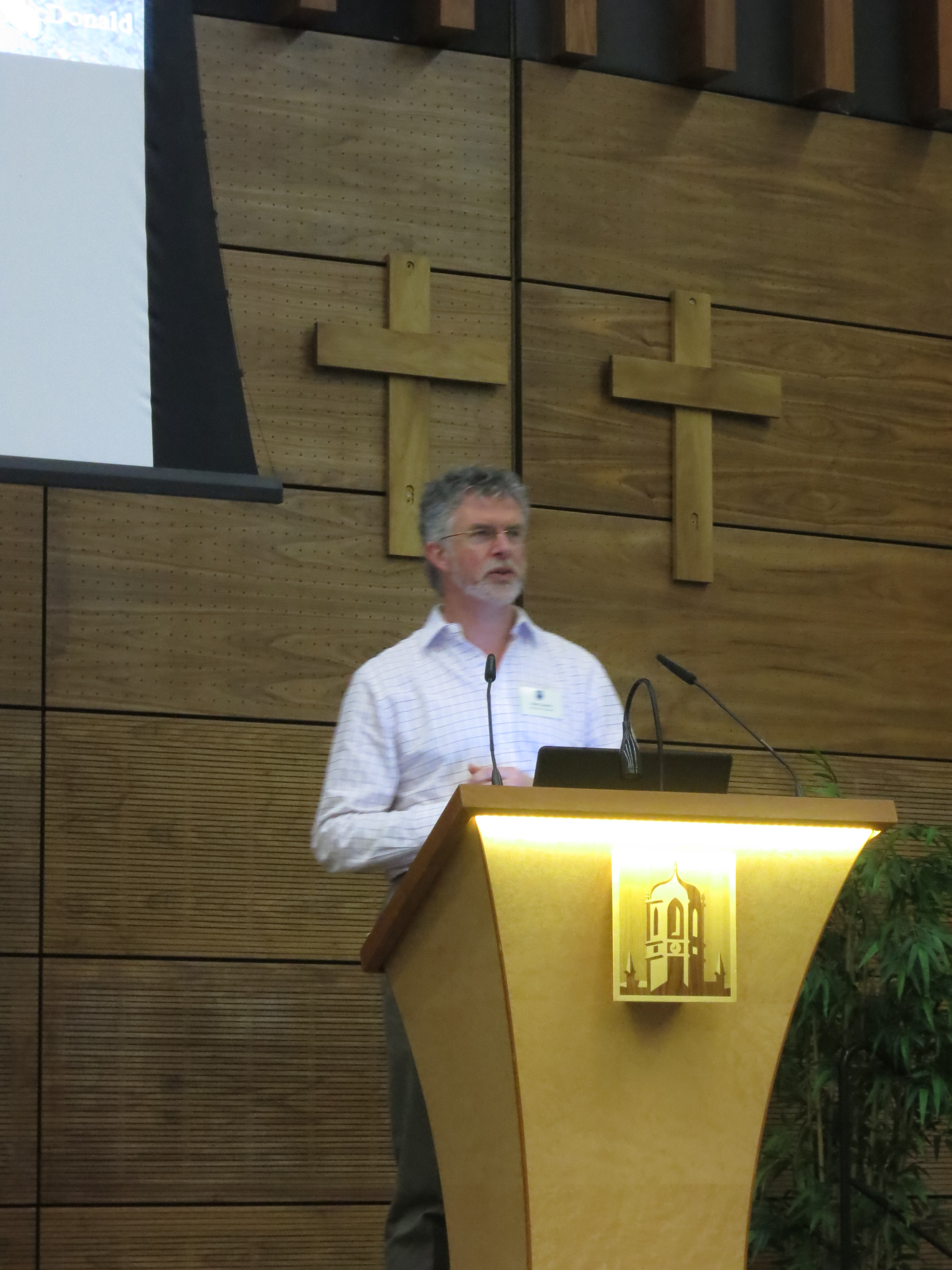
Opening speaker is Dr. David Connor, a marine biologist with over 30 years of experience in marine monitoring and surveying (including MESH, which maps the Baltic Sea), who is now on a loan to the EU for four years to work with the EU’s Water Framework Directive (WFD).

David shows many of the maps that they are now working on in order to get an overview of Europe’s seabeds. The maps have a resolution of 250x250m per pixel. Imagine that for a terrestrial map…However, it is much more difficult, and expensive, to make detailed maps underwater.
In addition to identifying the type of bottom substrate (sediment, rock, sand) they aim to include biological factors, energy exchanges and much more. The goal is that the European seabeds will be mapped down to 5000 meters depth, with relevant factors and good resolution.

Matt Frost followed with a talk about the benthic habitats and their classification in the EU’s Water Framework Directive, and whether there is such a thing as a sustainable habitat loss and if you can measure it to calculate when it is no longer sustainable. The basis for this work is the EU’s Habitats Directive. The data he shows includes more than one hundred researchers’ work over some years, published in the chapter “Habitat thresholds” in the report State of Seas from 2010.

Matt highlights the problems with getting hold of reliable data from all countries, and the difficulties in collecting good quality data at different depths and in different environments.
He concludes by saying that more research is needed before we can set quantitative targets for habitats, that we need to work out better methods for mapping, and that it is not possible to either set or verify quantitative habitat targets at present.

Dr. Xabier Guinda presents how they have managed to implement the EU’s Water Framework Directive for intertidal and shallow areas in Spain, France and Portugal, and the methods they have used to identify them. Primarily, they have used transects, which is the same as we do in Sweden.

Artem Isachenko presents how they have been able to identify mudflats with the presence of Arctica islandica (Ocean quahog) in the White Sea (where we from the BalticSeaWeed blog are eager to go for collecting some seaweed). To find relevant bottoms with the right type of sediment, they use side-scan sonar in Rugozerskaya strait, and received some very fine maps of bottom topography.

They even managed to interpret the sonar signal to determine the density of the large, very thick shelled Ocean quahog in the sediment, where it lives burrowed. Very convenient and comfortable!

They also checked the calculated numbers by taking pictures of the mudbottoms and count the number of Ocean quahog siphons sticking out of the mud (they are easy to recognize). The study shows that Ocean quahog can live in densities up to 400 individuals per square meter!

Henna Rinne, our Finnish colleague and friend, finish off the habitat mapping theme by presenting data from FINMARINET, which she has worked on for almost ten years. The Project is part of Natura 2000, where they have worked with habitats sandbanks (1110), reefs (1170) and small islands and islets (1620). The numbers are the code of the habitat within Natura 2000.

One of the biggest problems they have encountered when trying to map the coast of Finland is to get data. It exists, but is classified. If they get hold of the data, they are not allowed to publish it. Being from Sweden, we recognize the problem and sympathize. Today when every row boat has an echo sonar and a GPS with better resolution than many charts, one might feel it is no longer necessary to protect the depth data from Charlie (which certainly may find whatever data necessary for an invasion via Google Maps).

After a cup of tea and a stretch of the old legs, it’s time for one of the conference’s two female keynote speakers (a total of 9). Professor Maria Byrne did her bachelor here in Galway, but has since moved to Australia and work with echinoderms.
The presentation is about how the echinoderms entire life cycle, from egg to larva to juvenile and adult, is affected by changes in the aquatic environment. For a species to be able to survive in a changed environment, all stages of the life cycle must be able to be completed. Echinoderms builds up their body with calcium carbonate, so the major threats are ocean acidification (see yesterday’s talk) and increased water temperature.

Two species of sea urchins has clearly been affected. A cold-water species creeps slowly down towards Antarctica and have decreased along the Australian East Coast (Great Barrier Reef), while a temperate species have increased in number and extent as the water has become warmer.

Maria and her research group has investigated whether the response to the stress of increasing temperature and acidification are different, depending on whether the species is a polar water species or from temperate waters. It seems that the polar species are most sensitive to a decrease in pH, whereas species from temperate and tropical waters seem to have a greater ability to cope with acidification. Lowered pH seems to be the most important factor for the survival and growth of sea urchin larvae.

If one then adds a temperature rise of 3 degrees Celsius to different acidification stages and try it on the tropical sea urchin Tripneustes gratilla, commonly farmed as food in Asia, one sees that there is a clear synergistic effect on the growth of the larvae, and in later stages of life also in the gonads, which is what you eat. Thus, if it just gets a bit warmer, but not much more acidic, the urchins from tropical waters thrive down in South Australia in the future. The question is how it will affect the rest of the ecosystem. Sea urchins are known to graze heavily on seaweed!

In Starfish, they have instead seen that a rise in temperature inhibit growth. It seems that the sensitivity lies in the planktonic stage, so that species that have larvae with short planktonic stage, who does not need to build skeletons before they settle on the bottom, are less affected.

It’s always great fun to listen to someone who has worked for long in one area and it is a shame that time passes so quickly.

Day 1 EMBS Galway

After an opening welcome by Herman Hummel and Bob Kennedy, the first day started with four talks about climate change.

Opening speaker is Professor Jason Hall Spencer from Plymouth University, England. Jason and his team are focusing their research this year on deep coral reefs in the Arctic, satellite tracking of fishing vessels in order to identify possible marine protected areas, as well as studies of underwater volcanoes and how to use these to predict the effects of acidification by elevated levels of carbon dioxide in the atmosphere.

An increased amount of carbon dioxide in the atmosphere affects the balance of carbonate and bicarbonate in the sea, and thus all the animals that build shells and skeletons of lime (clams, snails, corals, echinoderms, etc.). The effect is an ocean acidification (OA). Acidification is measured as pH, where a value above 7 is alkaline and below 7 is acidic. The pH of the ocean has fallen from 8.20 in year 1800 to 8.05 in year 2000. It may seem little, but one should keep in mind that pH is measured on a logarithmic scale. One can already see the effects of mussel larvae, which is 20% fewer larvae in water with lower pH.

Another effect of the increased amount of carbon dioxide in the atmosphere is increasing temperature. This affects several marine species, who are unable to survive in high temperatures. Temperature in combination with acidification can have devastating consequences for marine life on a global scale.

To try to understand how acidification and temperature rise will affect the different ecosystems of the oceans, researchers are trying to conduct experiments that extend over a longer period of time, preferably over a few generations of different organisms, in order to distinguish the cause from the effect. The difficulty is to include all parameters when doing an experiment in the lab, and time is always in short supply for ecologists.

Naturally acidic areas in the ocean can be found outside Sicily, where cracks from Mount Vesuvius are bubbling up carbon dioxide into the water column. Here, the researchers have placed various organisms and examined how they were affected by the lowered pH. Several of our larger species, such as the sea grass Posidonia, seems unaffected, but many of the species found in seaweed beds are adversely affected, sometimes missing altogether. It is mainly red algae with a high calcareous content disappears.

Another potential problem is that other invasive species will gladly take over where seaweed has disappeared. It may seem good that someone fills in the gaps, but these algae do not have the same ecological function as seagrass, and also prevents the seaweed from reestablishing. There is a difference between macrophyte and macrophyte, indeed.

What happens if you move animals with calcareous skeletons between low and high (normal) pH? Depending on the organism you move, they are affected more or less. Some clearly show that they are capable of moving between normal and acidic pH as long as it’s cold, but if it occurs during the summer when it’s really hot in the water, they die.

Jason concludes that we must classify carbon dioxide as a marine pollutant, and the faster we can get policy makers and politicians to understand this, the better.

Dr. Andrea Gori continued in the same vein by showing how beautiful cold-water corals, mainly Dendrophyllia cornigera, are affected by rising temperatures and acidification. Dendrophyllia can be found at 200 m depth off the Canary Islands, where it is the dominant benthic (bottom-dwelling) species.

The results show that these corals can handle a fairly wide range of temperatures between 8-16 degrees Celsius. The study also shows that the species seem to thrive and grow better in temperate environments (12-16 degrees Celsius) than in cold water, where Lophelia pertusa is the dominant coral species.

Our Finnish colleague Tiina Salo, presented data from studies on Zostera marina (eelgrass), which she performed at Roskilde University in Denmark together with dr. Morten Foldager-Pedersen.

Tiina preaches seagrass

Tiina preaches seagrass

Tiina and Morten have examined the interactive effects of salinity and temperature, which has not previously been done for seaweed. The scenario is particularly relevant for the Baltic Sea, where a reduction in salinity is expected to be the largest impact of the ongoing climate change.

The study shows that salinity and temperature have a combined effect on the seaweed, especially on number of leaves formed in both young seedlings and adult individuals. Generally, young plants are more sensitive than adults, and they died completely in the treatment exposed to the highest temperature and lowest salinity.

Thus, future climate changes affect eelgrass in the Baltic Sea, and its vegetative propagation will be more important for the species’ distribution and survival.

Last out before the coffee break (or tea, this being Ireland), is Dan Smale with a summary of Extreme Climatic Events in the marine environment, or Marine Heat Waves, and how they can affect entire ecosystems.

The example is the heat wave along the west coast of Australia in 2011 caused by extreme El Niño conditions, that lasted for two weeks. Before the heat wave there were dense kelp Forests. These could not survive the heat, as they were already living on the edge of their heat tolerance. When the kelp disappeared, the cleared surface was covered again with dense turf algae that effectively prevent kelp from coming back.

The kelp forest has decreased significantly, and this has in turn affected the amount and species number of fish found in these areas. In the region where the kelp previously existed, were also previously found 6 species of mobile invertebrate fauna (sea urchins, snails, etc.). These species have not succeeded in re-establishing themselves in the affected area, as their base habitat, kelp, is no longer there.

Since only two weeks of heat can have such a major impact on an ecosystem, one dares hardly think of how a long heat wave would affect marine life.

Mark Costello - on a divine mission

Mark Costello – ona divine mission

After refreshment of coffee, tea and cake, the last session of the day is opened by Professor Mark J. Costello, a heavy name in marine biology, who among other things, helped to found WoRMS. He starts off by pointing out that in the Bible’s book of Genesis, God gave man the task of naming species (and maybe a few more irrelevant tasks as well), and that he, as a taxonomist, is working on it. The title of his presentation is “Can we discover Earth’s species before they go extinct?”

The estimated number of marine species that we have identified today is between 320,000 to 760,000 if you use the WoRMS database, and 704,000-972,000 using different assumptions and methods, often described as expert estimations. Mark highlights how inadequate sampling methods may produce very large differences, and why it is obvious that there are more species in the oceans than on land, when seas are so much greater.

Hardly surprising, physically large groups, such as birds, whales and turtles, were early discovered and mapped (if not hunted to extinction), while smaller organisms like bryozoans and tube worms have been “discovered” in greater numbers during recent years. Looking at the timeline of species Discovery, it shows a marked peak in year 1900, when some big expeditions went out and collected large amounts of marine animals. The trend, of course, fell during the World Wars, but has climbed steadily since the 1950s. Some species, however, have been described several times. Spermwhale has no less than 19 (!!) different scientific names. Sometimes itis because the species look different as young and adult, or because the male and female have completely different colours.

Mark estimates that only 61-64% of the planets alge are described (micro and macro algae). If you divide up the animals in the micro fauna (less than 1 mm) and macrofauna (larger than 1 mm), one sees that there are ten times as much microfauna than macrofauna. One can discover a lot by seeing the world through a magnifying glass or a microscope.

The humor reaches the nerdiest of levels, when he shows diagrams of how taxonomists (someone who works with describing new species, like Linnaeus) have increased over the years, although rumor has it that they are becoming extinct, how it differs for marine and terrestrial, between single versus co-published species descriptions and across the continents. He concludes by summarizing that taxonomists are not an endangered genus, but that it presumably requires more work to find new species today when so many are already described. He criticizes the articles that claim it is because the species are dying out at an accelerating rate.

It’s….the 48th European Marine Biology Symposium!

This year’s edition of the EMBS, the 48th, will be held in the charming city of Galway on Ireland’s west coast.
During the week, you, dear BalticSeaWeed blog reader,will be able to keep up with the events, which we do our best to serve piping hot.

The programme is full of interesting presentations and posters. New for this year is the possibility to also present posters with a video on YouTube in order to really reach out with the results. We think that’s a brilliant idea, since Poster sessions are often a bit crowded and bustling, where long explanations and discussions can be difficult.
We also note that both Finnish and Estonian colleagues will contribute with interesting seaweed-talk.

Naturally, we hope to take a stroll along the beach to collect some seaweed for the herbarium. We have already found the seaweed products in stores.

The big question is which team will take home the Yellow Submarine this year. Don’t miss out on this!

Field season in full bloom

The days are just soaring by as the field season hits its high peak.

Helping us in this organized chaos is Frances Ratcliffe, volonteering marine biology student from UK. It’s such a help to have an extra pair of hands. We are very glad to have her with us.

Frances and bladderwrack!

Frances and bladderwrack!

The week before last was spent at the Askö laboratory, were we ran the Baltic Sea part of a two-station experiment wich will look closer on the effects of grazing snails on seaweed.

First, we put the seaweed (Fucus vesiculosus and Fucus radicans) grow a while without any grazers, in order to get undamaged tissue.

Seaweed growing

Seaweed growing

After a couple of weeks, we placed the tips in jars with gastropods (marine snails) and let them graze for a couple of days. We so hope that they were hugry and ate a lot, so that we can see the grazing damage under the microscope later on.

45 jars with gastropods and an even flow of water. Amazing what you can build with a pipe and some hose.

45 jars with gastropods and an even flow of water. Amazing what you can build with a pipe and some hose.

Once the seaweed was grazed, we collected some Ulva intestinalis, a green algae, and made it release its spores.

<img src="http://tangbloggen.files.wordpress.com/2013/07/entero1.jpg?w=300" alt="Ulva intestinalis spores makes the water go green.” width=”300″ height=”224″ class=”size-medium wp-image-910″ /> Ulva intestinalis spores makes the water go green.

What we hope to see is if the spores will be able to grow on the grazed surface of the seaweed.

<img src="http://tangbloggen.files.wordpress.com/2013/07/sdd201.jpg?w=300" alt="We have seeded the grazed seaweed by poruing spores of Ulva intestinalis in the water” width=”300″ height=”224″ class=”size-medium wp-image-920″ /> We have seeded the grazed seaweed by poruing spores of Ulva intestinalis in the water.

Let’s keep our fingers crossed and hope that it grows!

The week that was and this week, is spent at Tjärnö laboratory on the other side of Sweden, were we are running the same experiment, but in saltier water and with Ascophyllum nodosum instead of Fucus radicans and with other gastropods.

Our lives have been made so much easier thanks to Marit, who is doing her master thesis together with us. She has tended to our experiment so that we didn’t have to go back and forth between the coasts like crazy. Thank you Marit!
Meanwhile, she has also done an enormous fieldwork on a very interesting study on gastropods and seaweed, that we hope to write more about here on the BalticSeaWeedBlog.

Marit shows her disected gastropods.

Marit shows her disected gastropods.

it is always nice to meet and talk about seaweed. We had many nice discussions on this fascinating topic.

Frances, Marit and Lena discuss seaweed at Tjärnö Laboratory.

Frances, Marit and Lena discuss seaweed at Tjärnö Laboratory.

Seaweed in the Quark is now mapped

The Finnish Forststyrelsen, together with Länsstyrelsen Västernorrland and FOI have developed a method using LIDAR and SCUBA diving in order to make more large scale mapping of fucoid belts in the Bothnian Quark. This is a very important tool in environmental monitoring, since this can be used in calculating more exactly the areas of seaweed affected positively or negatively by environmental change.
To see the nice map of Norrskär that has been constructed, click HERE.

Gold medal to professor Lena Kautsky

Vice-chancellor of the University of Stockholm has decided to distribute the Stockholm University gold medal of the 8th size in ribbon to three persons who in various ways have promoted the University’s activities.

One of these is the BalticSeaWeed blog’s very own Professor Lena Kautsky.

The motivation reads as follows:
“Lena Kautsky, professor of marine ecological botany, is awarded Stockholm University gold medal of size 8 in ribbon for her deep involvement in marine research and education at Stockholm University, in national collaboration on marine environmental issues and sharing of knowledge to the public and decision makers. Her leadership of the Stockholm Marine Research Centre and Asko Laboratory has been a decisive part in the fundamental work resulting in Stockholm University’s new Baltic Sea Centre. ”

The medals will be awarded at the installation ceremony held at City Hall on September 27th.

The BalticSeaWeed blog, swelling with pride, will of course post pictures from the ceremony.

See also university’s website (in Swedish only).

Seaweed course in Denmark

The week has been spent in Denmark, on a full Sunday to Sunday course to learn more about macroalgae.
With a schedule so full you can hardly fit it to a paper, the hopes and expectations to become a real seaweed guru are high.
There are 11 PhD students partaking, all from different countries!
The course is arranged by Aarhus University, as you can see in their newsletter (sorry, only in Danish).

Our first day of the course, we went out to collect macroalgae in the field. We started at the pier next to Ebeltoft harbour, where the sun shone and it was lee on the inside where we were working. I took this years “first swim without a drysuit in Nordic waters”. It was a refreshing 16 degrees Celsius and I was in the water for about 10 minutes, collecting material. Here there were four Fucus species growing: Fucus spiralis, Fucus vesiculosus, Fucus evanescens and Fucus serratus. Jackpot!

Lots of seaweed!

Lots of seaweed!

After a field lunch of sandwiches, we headed north, to Grenaa. Here, the Marine Home Guard and their boat took us out on Kattegat! What a luxury! This is a new collaboration between the Home Guard and Aarhus University, so the Danish TV was out and filmed us. Click here and fast forward to 1:19 into the clip and there we are.

Monday evening and Tuesday was spent going through the collected material to determine the different species and look at their different physiological structures.
On Wednesday, we tried to reproduce sugar kelp ( Saccharina latissima ) by getting them to release spores. It didn’t quite go as planned, so we took some good old bladderwrack and got it to release eggs and sperm instead.

On Thursday, we went to Algcenter Grenaa and had a look around. Pictures from our visit you can see the Algcenter website

Anette Bruhn show us how they cultivate sugarkelp at the Algcenter

Anette Bruhn show us how they cultivate sugarkelp at the Algcenter

We also got to visit the Kattegat Center, located just across the parking lot. This is one of Denmark’s many fine aquariums that have long been on my wish-to-see list. It was just as good, if not better, as I had expected. There was even an exhibition of algae and their importance. It is totally worth a visit!

Friday and Saturday were devoted to compiling and analyzing all of our data, and then present it in four groups according to various themes (Taxonomy, Monitoring, Light and Cultivation).

Danish seaweed; red, brown and grøn

Danish seaweed; red, brown and grøn

Seaweed project within BalticSea 2020

Anyone who is interested in the Baltic Sea might have heard of Baltic Sea 2020 Foundation.
Baltic Sea 2020 is a foundation founded by Bjorn Carlson through a donation of 500 million SEK (55 million EUR). The Baltic Sea 2020 Foundation’s assets shouldfund projects that are action-oriented, innovative and helps to improve the knowledge of the Baltic Sea continuously until 2020. The BalticSea 2020 Foundation began its work in 2006 and has to date initiated more than 70 projects, of which 25 are ongoing.

One of these projects is about trying to re-establish bladderwrack inside Björnöfjärden, a bay outside Stockholm. Björnöfjärden is heavily eutrophicated and the water is quite turbid with particles that prevents the light from penetrating. It quickly becomes dark below the surface, so that only a few stands of seaweed survive here. Observant locals have informed us that there was plenty of seaweed in the Björnöfjärd in the past, however.

So, seaweed enthusiasts to the rescue!

Susanne Qvarfordt is ready to establish bladderwrack.

Susanne Qvarfordt is ready to establish bladderwrack.

Susanne Qvarfordt from the environment surveillance company Sveriges Vattenekologer has initiated a project that will examine what factors might prevent the seaweed population from re-establishing in Björnöfjärden.
In addition, she asked the BalticSeaWeed blog to help with our expertise!

So, during the first days of June, we collected fertile tips of bladderwrack. These were sexed (we cut the receptacles and see if they are male or female), so that we would get an appropriate ratio of males and females at each site.

Sexing seaweed is best done with a scalpell and a magnifying glass.

Sexing seaweed is best done with a scalpell and a magnifying glass.

The bladderwrack were made into small beautiful fertile bouquets which were then attached to a grid. These will be placed in the water, floating over a number of concrete plates, and hopefully make new small seaweed babies that can attach itself to the plates.

All is ready for a baby boom!

All is ready for a baby boom!

So, now we have placed three grids in Björnöfjärden and three in nearby Fjällsviks Bay, to see if any of the other actions carried out in Björnöfjärden will affect the seaweeds ability to reproduce.
So, keep your fingers crossed that no one gets caught with their anchor or fish tackle in our beautiful grids, and hope for calm weather at Midsummer full moon so that there will be many wee ones.

Placing a seaweed grid with buoys.

Placing a seaweed grid with buoys.

Around Gotland

Yessiree! It’s time to jump into the water again!

After a long winter with lots of ice, and a well deserved trip to warmer water, it was time for yours truly to submerge oneself into the cool waters of the Baltic Sea.

Field season 2013 opened on Wednesday 22 May at the scenic island of Gotland, jewel of the Baltic Sea.

For the faithful reader, it comes as no surprise that it was time for the inventory of summer reproducing bladderwrack around this beautiful island, as part of the investigation we made along the mainland coast and Gotland last year (see previous post on Tångbloggen 2012 – A seaweed odyssey).

Gotland is well known by many botanists for its amazing flora, and the orchids certainly fought for space with primroses and lily of the valley along the road as we drove north from Visby up towards our first stop just south of Lickershamn.

Orchis mascula- Early purple orchid

Orchis mascula- Early purple orchid

Unfortunately, I think most people fail to see how beautiful Gotland is below the surface. The clear water and the dense seaweed forests are magically beautiful and are conveniently found at knee-depth in the water. If you do not like to get wet, you can easily experience life below the surface with a pair of high rubber boots or waders and water binoculars.

Our second stop was out on the island Fårö, at Lauter huvud. At the moment it’s a rather low water level in the Baltic Sea. It is caused by the weather and is not unusual this time of year. But it gets a little tricky to swim when you are constantly running aground. It was easier to walk among the rauks and occasionally stick my head under the surface in order to verify single specimens of Fucus. Quite possibly the occasional tourist who stayed at the car park was wondering what we were doing. One is not exactly discreet in a bright red dry suit. Hope I did not destroy too many photographs by emerging between rauks like a jack-in-the-box.

Having swum a little off the cliff edge, where it goes from 0.5 meters deep to 15 meters, we went to today’s third and last site at Östergarn.

Here the waves rolled in with a quiet rhythm, and if I had not been busy counting, I would certainly have fallen asleep, it was so very peaceful. The sun had come out and warmed my back as I floated about. I saw plaice, viviparous eelpout (Zooarces viviparus), stickleback, and Lesser pipefish (Syngnathus rostellatus).

Plattfisken vilar bland tången.

The plaice is resting among the seaweed.

The night was spent at the nice hostel in Hemsedal, which had very comfortable beds.

Thursday morning began with a trip down to the southernmost tip of Gotland, the Hoburg. Here we encountered more nature lovers in the form of a flock of birdwatchers. The species often nests at the southern tips of both Oland and Gotland and is easily recognized by the telescope that is often worn over the shoulder.

I even saw Red-Backed Shrike (Lanius collurio), Northern Wheatear (Oenanthe oenanthe) and a yellow bird that I didn’t recognize.

The sea was calm and the swans that landed some distance away did not attack the red ball splashing around, muttering through a tube (snorkel). It was nice to see that htere were many small juvenile seaweed individuals there. Reproduction last year was apparently very successful. Always a good sign.

Our last stop for a dip was just south of Klintehamn. On the way there we visited the nice naturum center in Vamlingbo for a short break. With coffee in the body, we parked at what must be Gotland’s busiest road, and changed into work clothes.

“When you take off your pants, five cars and a bus will always appear” – Old jungle proverb

It was the only site with lots of bladders on the wrack! One might think that bladderwrack always have bladders, but no! If the site is exposed to strong wave action, no bladders are formed. This is to minimize wave grip, so that the wrack does not get torn off by the waves.

Blåsor på blåstången - inte en självklarhet.

Bladders on the bladderwrack – not always to be expected.

It was plenty of gammarids, prawns and isopods here, and I hope I got a picture of the Lesser Pipefish hiding amongst the seaweed. It was obvious that there is a lot of nutrients coming out into the water as runnof from land. The seaweed had much filamentous algae growing on them. Swimming across it reminded me of a shaggy rug.

After again having fulfilled the jungle proverb (Why?!?) we headed towards Visby and enrolled into the prison. If we get out tomorrow remains to be seen.