“Cinema Seaweed”

Here in Sweden, the frost is making everything sparkling white, and our noses and cheeks red. So what could make us warmer than some Cinema Seaweed? During summer and autumn, several seaweed movies have appeared on YouTube. This is a trend that we hope will last.

Here are links to nice seaweed movies that we have come across.

Nyköpings municipality, just south of Stockholm, has really got the hang of how to show itself from its best side!
Here you can see the two localities Långskär and West Kovik. The gurgling sound you hear is when the snorkel is filled with water.

From Skälderviken down south in Skåne county we can see that both bladderwrack and serrated wrack have recovered. It is also shown that 2013 was an incredibly successful year for the brown algae Dead Man’s Rope (Chorda filum) along most of the Swedish coast.
The movie is by Virtuerack. Virtue is a resource for schools, created by the Faculty of Science at Gothenburg University and The Maritime Museum & Aquarium in Gothenburg. They also have more movies where they show how cd-discs are being placed under a jetty in the sea and become habitat for several algae and animals.

Do you have any nice seaweed movies? Please let us know.

Chrismas is here!

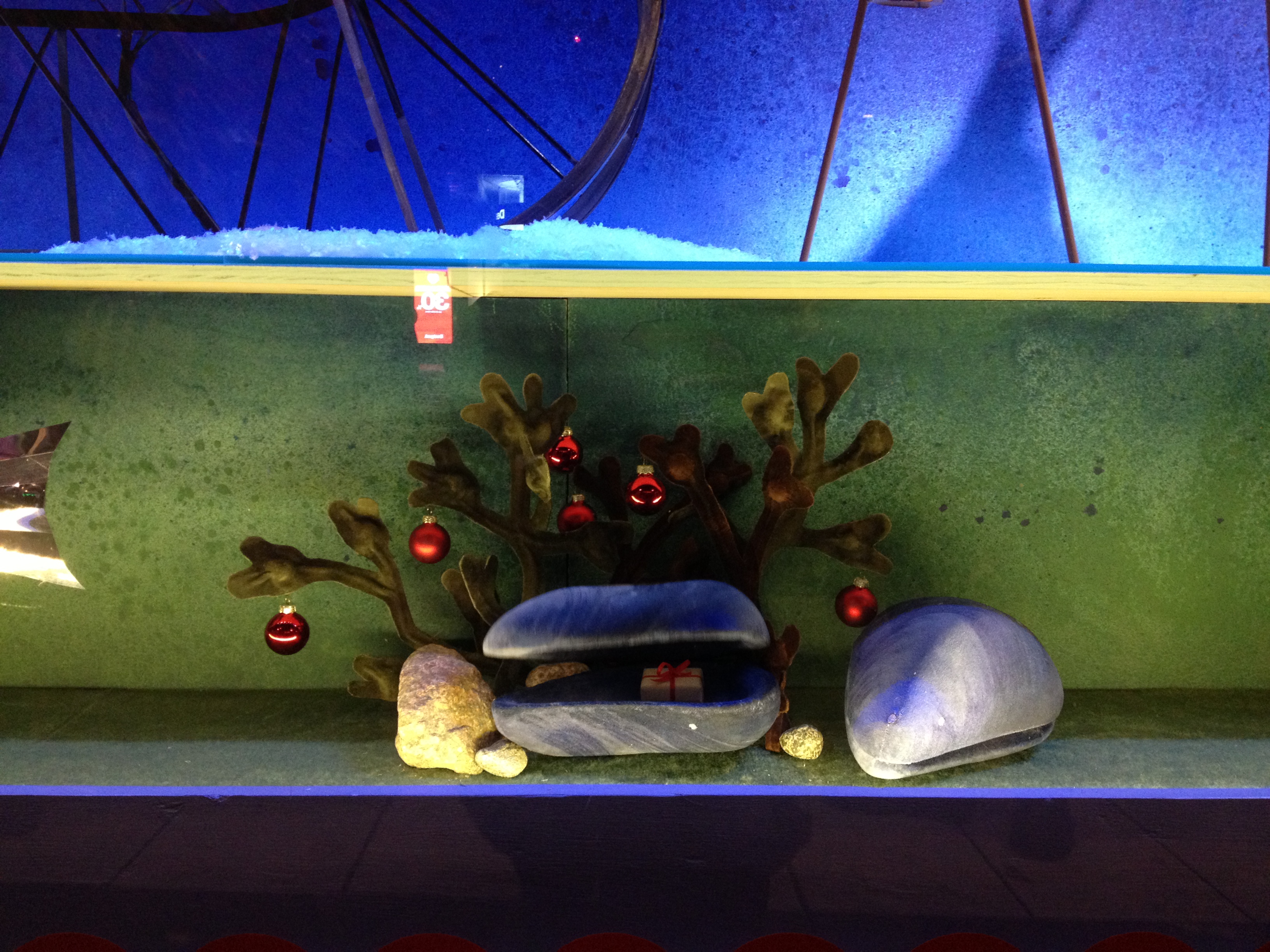
The Christmas decorations at the Nordiska Kompaniet department store in Stockholm was unveiled last weekend.
Several enthusiastic followers of the BalticSeaWeed blog have contacted us to let us know that this year, the bladderwrack takes part in the Christmas celebrations.
There are also some lovely fish, a blue mussel with a small parcel, dancing starfish and a sea urchin snowman.

No Christmas without seaweed.
Wonderful, says we from the BalticSeaWeed blog!

Who needs a tree when there is seaweed?

Who needs a tree when there is seaweed?

Barnacles, bryozoans, seaweed and patterns

There are still some things to blog from earlier this fall. In August there was a seminar in the ”Sustainable Sea” -series, a co-operation between Briggen Tre Kronor and Stockholm University. The exhibit “The Baltic Sea- who cares ?” was also shown. There was displayed pictures from Hanna Henriksson’s exam project at Beckmans Design School, where she used wonderful patterns from the Baltic Sea, with barnacles, bryozoans and bladderwrack. Who would have thought that bryozoan colonies can be as lovely as the finest lace!

Image

Thus inspired, Lena made a kaftan that she wore on the 27th September when she was awarded a gold medal by the University, as we have previously mentioned .

Image

“It felt wonderful and very appropriate to walk up the stairs in City Hall and receive this honorary award from the Vice-Chancellor, wearing a dress with a pattern from a photographed settling-plate.” Lena said.
This particular plate was hanging at the Askö laboratory, and used for research on the settling time of barnacle larvae on boat hulls, some years ago. The results from this project and what each of us can do instead of painting our boats with toxic paint can be found at The Archipelago Foundation.

If you want to monitor when the barnacles of 2014 arrive at your own jetty or pier? Get a settling plate and hang it from the jetty. From The Archipelago Foundation, you can also find out what you can do once you see that they have settled and reached about 1 cm in size.
If they are on a small boat, you can just brush them off, or take your boat to a boat-cleaning station. You can also take your boat up a river or ia nearby freshwater area. This will kill the barnacles, who will eventually fall off.

Image

Autumn preparations at Askö Laboratory

Last Monday it was time to put the seaweed out in the sea for overwintering. After some different trials of overwintering indoors in the Experiment Hall at the Askö Laboratory, with extra lights and air pumps, we have found that it is still difficult to get good enough water circulation and movement for the seaweed to be happy. It becomes brittle and falls apart come spring. But tying plants on to net cages and placing them on the sea floor at some meters depth works just fine!
The weather was amazing. Calm and brilliant sun. But the water level was too high, so now they are places too shallow to remain in the bay all winter. We will have to come back later and move them to a deeper waters. That will be a dry suit -job.

Image

In this year’s seaweed plantation is material from Gotland that we have collected in order to try and solve the question of if there is a third ecotype of bladderwrack. We know from before that in the Baltic Sea we find both summer reproducing (end of May-June) and autumn reproducing (end July-October) bladderwrack. But now it seems that we have found a third type, that reproduces more or less constantly throughout the entire season (May-October).

Image

The Sea Environment Seminar of 2013, was held at Vår Gård located in Saltsjöbaden outside Stockholm. In the morning Lena went for a walk alongthe beach and found plenty of free-floating bladderwrack balls, both in the wrack wall on the beach and also floating in the shallow water, rolling around.

Image

According to litterature, these do not reproduce sexually, and we have never seen any reproductive tips on this form of bladderwrack. Naturally, she collected several wrackballs. Since Lena had forgotten to bring a plastic bag (wich is something a true marine biologist always should keep on her/him), she had to go back to the hotel reception and ask for one. Imagine their surprised looks. The day after, Lena went out to ASkö and tied the wrackballs to little ceramic tiles. What we are looking for is if these freee floating forms will become sexual in spring if they have a fixed up and down. Now they are placed in the sea for the winter, and all we can do is wait for the return of sunlight and warmth in spring, when we can dive down and check if there are any reproductive tips on them.

Image

“Science it’s a girl thing”

Sometimes you just don’t believe your own eyes.

The European Commission is running a campaign to get more girls (or women)into science, called “Science: It’s a girl thing”.

The idea is good, THIS VIDEO, however, is not.

Is the general European perception of women that for us, science is about making better makeup?

I’m lost for words. If science is a girl thing, then feeling insulted by this video must be a woman thing.

Please answer the poll and let us know how YOU do science, girl or no girl. WE are not gender biased.

Fucus radicans movie (in Swedish)

Film time!
It’s been a long time since we had any movies posted on the blog.

At the Swedish site havet.nu is a nice movie (5.35 mins) on Fucus radicans. Our esteemed collegue professor Kerstin Johannesson explains why Fucus radicans is so interesting from an evolutionary perspective “Smaltång och drivkraften bakom uppkomsten av nya arter (Fucus radicans and the driving force behind the origin of new species). It is only available in Swedish, with no subtitles, unfortunately.

Day 5 EMBS – The final sprint

It’s not fun to get the presentation slot first out on the morning after the conference dinner. But Katarina from Estonia got a good attendance and gave an interesting presentation on the zebra mussel (Dreissena polymorpha) and its impact on the ecosystem of the heavily eutrophicated Pärnu Bay in southern Estonia.

Maillie Gall from Australia told A story of two sea urchins, in which she compared the population genetics of the two sea urchin species Heliocidaris erythrogramma and Heliocidaris tuberculata to see how far their larvae spreads. She has primarily examined whether the duration of the planktonic larval stage plays a role for the spreading distance. It was very nice to rest those weary eyes on some beautiful pictures of sea urchins and Australian waters.

Jennifer Loxton held one of the conference’s coolest presentations, according to me. She showed how a bryozoan (phylum Bryozoa, it’s an animal) that came into English waters recently from Japan, reproduce like crazy. With movies and beautiful microscope images, we see that most of the currently known bryozoans form one egg bump per individual, where a larva is formed which then swims away and form a new colony. The Japanese moss animal produces up to five bumps, simultaneously! Unbelievable. The animal is red in color and thrives in cold water with high salinity, so we’ll probably not see it at the Swedish coast.

Final speaker of the conference was Paul Somerfield from Plymouth Marine Laboratory, renowned marine biologist and statistician, who talked about how to use statistics and not place too much weight on that which is odd or rare if one wants to describe an overall pattern. The presentation was entitled “Putting the species back into community analysis “. Funny, easy to understand and relevant!

Yellow submarine 2013

We prepared already on Wednesday evening by writing a team-song, in order to score some extra points. Unfortunately, wedid not get any opportunity to sing, but it will probably come other times when seaweed songs will come in handy.

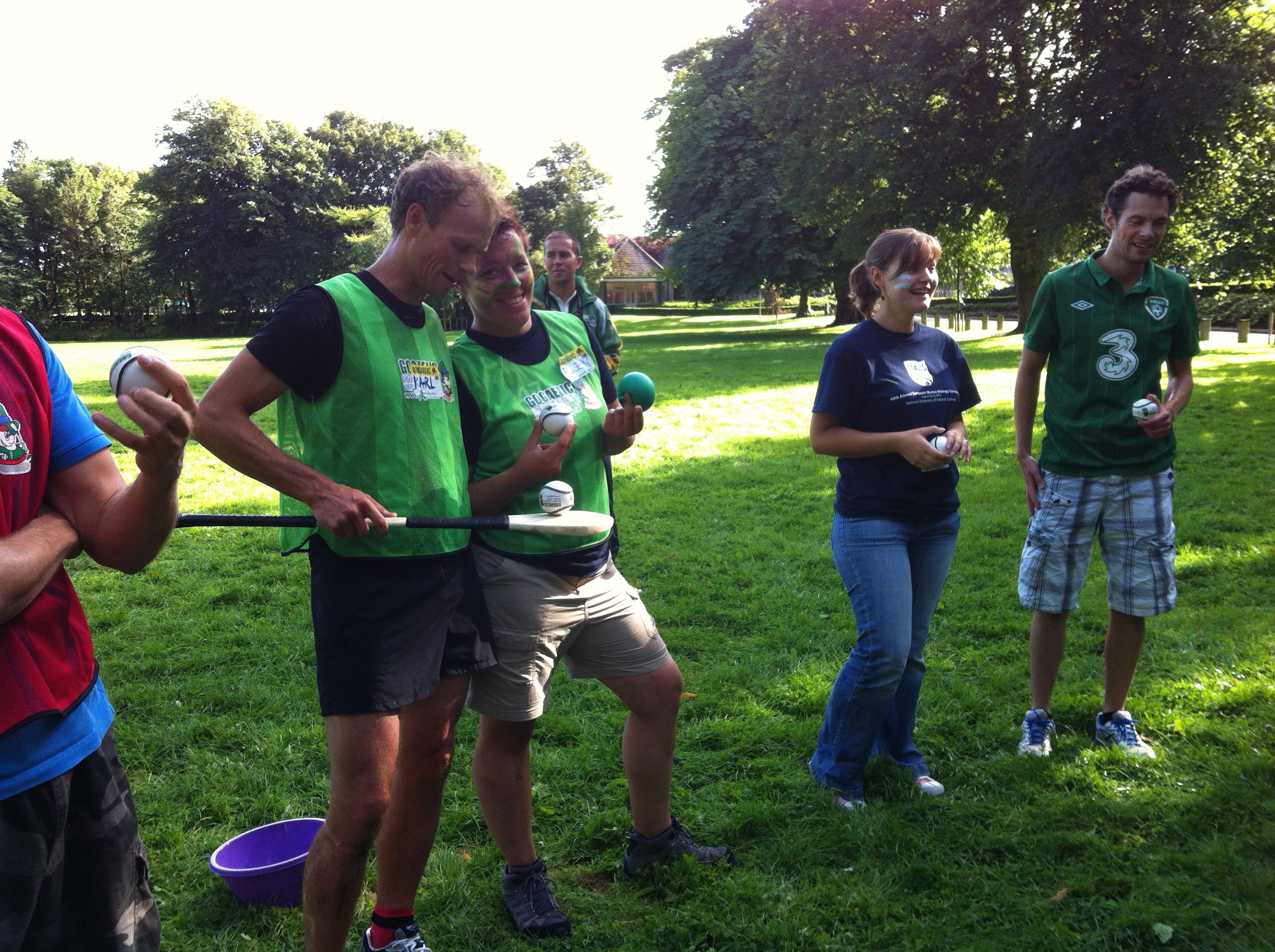
The theme of this year’s competition was gaelic games, which meant training in Irish football (much trickier than the old regular version) and hurley, which is a more violent version of the outdoor hockey …. sort of. You get a stick and a helmet! Fun!

In the first race, each team should balance cups of water on the Hurley stick through an obstacle course, but catastrophic cheating broke out, and developed into outright anarchy, so no points could be awarded. The Swedish-Finnish-Danish-Estonian team, however, had clearly the best technology before the sponge throwing went out of hand.

The final was a dramatic thing, Sweden loosing to Ireland with a hair, litterally. Thankfully there was not too much damage done when two heads were merged into one at high speed. Karl Norling is, as always, a rock.

eftertävlingen

The trophy was awarded later in the evening during the conference dinner under much applause. The evening continued with Irish dancing into the late hours. The BalticSeaWeed blog came home acceptably late and slept well, in order to get to the lectures tomorrow.

Day 4 EMBS Galway

Niall McDonough from European Marine Board started the day. European Marine Board is a partnership of 35 national marine / oceanographic research institutes from 20 European countries. Recently, it has also opened up for a membership of a consortium of universities. The Board is working as a platform to develop a common understanding of what is needed and what should be prioritized within marine research in Europe, and communicate this to policy makers in the EU. There are lots of interesting publications that can be download for free on their website http://www.marineboard.eu
For those who want to learn more about the sea, they are also running a project called Ocean Literacy, wich we will look into more closely and get back to you on.

Brenda Walles from the Netherlands present us with more information about oysters, wich we like a lot, especially with garlic. She has further investigated the possibilities of using oyster beds as erosion protection (bioengineers) on exposed coasts. Today, they are used mostly as breakwaters, but they also have a greater impact on sediment bottoms around them. The most important factor for optimum protection has proven to be the length of the reef, not surprisingly, but the oysters also have more beneficial bioengineering effects that could be utilized better than we do today. And they are so very tasty…

Katrin Bohn from Southampton University has participated in a study of re-colonization of old boat docks in Liverpool that were restored in the early 1980’s. The study was begun several years ago by Professor Stephen J. Hawkins. The restoration wincluded removing large amounts of accumulated sediment in the docks and putting back the gates in order to control the water flow. The water clarity and the oxygen concentration in the dock improved significantly during the first six years, and now mussels, sponges and sea squirts have moved in.

Day 3 EMBS (getting tender, the chairs are hard)

Today we began with oxygen-free bottoms off the Mississippi River delta. Mississippi has a catchment area covering more than 40% of the U.S. and even reaches in to Canada. Totally awesome! What the researchers have seen is that when large masses of fresh water floods into the sea, after Heavy rain and storms, zones are formed that are completely anoxic, lasting for various length depending on amount of water. Clifton Nunally is working in the area, known as The Mississippi Dead Zone. Dramatic!

Karin Troost from Holland asked whether the pacific oyster (Crassostera gigas) is taking over mussel beds in the Wadden Sea off the Dutch coast. It seems to vary depending on where along the coast they are investigating. Eastern Wadden Sea is now heavily dominated by oysters, but they also create a substrate for mussels, so the result is mixed beats with both mussels and oysters.
In the western Wadden Sea, oysters have colonized areas outside the mussel banks instead.
It seems like there is no need to worry, the oysters will not outcompete the mussels. They will move in and create mixed banks, with more complexity than before. What we do not know yet is how oysters moving in will affect the birds that eat the mussels. Will it be more difficult for them to access mussels? Also, oysters have incredibly sharp edges which birds might rather avoid. The question is also whether there will be food for both oysters and mussels to grow properly, something that Karin is working to calculate.

Sarah Ann Woodin from the U.S., now retired (which does not mean that she no longer does research), show how they have mapped the distribution of larvae from the polychaete Diopatra along the European coast (yeah, she has been sponsored by NASA). This worm builds lovely pipe-formed houses out of shell pieces. The worm larvae spread both naturally through the ocean currents, but also by human impact, hitchiking on mussels that are moved between different cultures along the French coast. It is an incredibly large study, but the advantage is that they get to eat as much mussels as they like while they are working. Wonder if they need an assistant?

In the afternoon, our Estonian colleague Jonne Kotta talked about the importance of temporal and spatial scale when talking ecology, and on what scale you are seeing changes caused by the climatic conditions. Changes on land, like the floods that hit Europe during the last year, for example, are obvious and get a lot of media attention of course. But the changes that occur in the water is not as high profile, and not as well mapped. Jonne has been part of mapping much of the Estonian coast. Once again, the problem with the absence of high-resolution maps of the sea, that we only see tiny parts of the seabed and that the amount of modeling required also need to be checked with actual observations, is discussed.

The second (and last) female plenary speaker of this conference is Cindy Lee Van Dover, who is working with hydrothermal vents (like chimneys of hot water from volcanoes on the sea floor). Her presentation is about the impact humans have on these communities as they mine these habitats for minerals. These environments enriches several minerals from sea water and can grow very large. One such, Godzilla, was 15 storeys high (!!!) before it collapsed during a small local earthquake in 1996.

It’s incredibly exciting with deep-sea research, in which ecosystems are not based on plants that capture solar energy, but is entirely chemosynthetic, wich means that they are instead based on sulfur. Cindy shows stunning images of volcanoes erupting under the water and what it looks like one, two, and three years later, when the animals will return and new structures are forming.

There are one or two embarrassed laughs as she shows different categories of trash you find in the deep sea around these environments. Most are scientific instruments left behind. Luckily, they are mostly classified as less disruptive to the environment. Since this type of environment was discovered 34 years ago, scientists have made more than 700 visits down to there. It leaves a lot of research equivalent of coffee cups and cigarette packets.

So, the problem arises if you venture to mine for minerals, mainly sulfur in these areas. When structures that are built up of mineral deposits disappears, the animals that depend on those structures for living environment and nutrition also disappears. Mining the sea floor also means that it whirls up a lot of sediment, something that many animals do not appreciate. The actual process of mining today, includes pumping shallow water down to the depths, causing a chemical imbalance.

Cindy does not condemn the mineral mining, which has not actually started yet in the areas she works with, but is concerned that they should set limits on how much of these unique environments you are prepared to lose and ensure that these limits are followed before embarking. Here’s a chance to do it right, or at least make minimal mistakes.

Hege Vestheim, originally from Norway, does research on deep sea brines (super salty water layers) in the Red Sea at Saudi Arabia’s University in Jeddah. Hege has investigated 25 deepwater basins along the Saudi Arabian coast that has extremely high salinity. Here, the environment is so extreme that they found no life at all in some of these basins (a dead octopus does not count). In some of them they found arrow worms (Chaetognatha), a clam of the family Solemya and some small anemones that sat on a protruding structure. But as they explore these salt pools they find more and more species, and we were shown an ROV video from some of the pools at more than 1000m depth, with several fun new species. Cool, Hege!