Seaweed on the rocks

It is SUCH an advantage to have access to an ice breaking ship when one works with seaweed.
Mid-March is unfortunately not always full of sun, birdsong and warm spring temperatures.
On March 18th, we wrwe out at the Askö laboratory to do a reading of some experiments that have been out in the sea over winter.

Havet the door

With a lilttle help from the ice breaking R/V AURELIA and skipper Eddie, I could reach one of the sites, located just south of the boathouse.

The seaweed has not suffered from the cold winter, but was in good shape. When I lifted the “weedbeds” up onto the ice, lots and lots of animals swam out. Small crustaceans, gastropods and caddis worms a plenty, all of them have spent the winter in the seaweed.

Tång o is

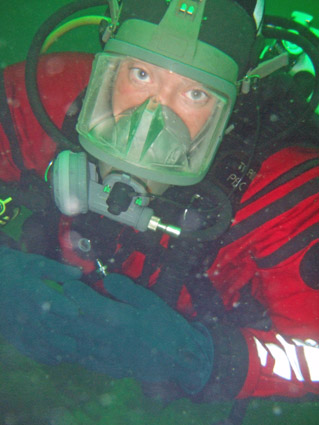
Allthough the visibility in the water is very good this time of year, and the temperature is, well, shall we say refreshing, I can’t help but longing for summer. It is quite a struggle to move large sheets of ice when one is i the water…

Join us diving for seaweed

On Thursday, you can join us under the surface and experience what it is like to scuba dive WITHOUT GETTING WET OR COLD!

How on Earth will that be possible?

On Thursday 21st we will have a sneak start on World Water Day! Come to Aquaria and join the BalticSeaWeed blog, who will get into the water to check on a seaweed experiment. You can also help feeding the animals at Aquaria and get answers to everything you’ve always wanted to know about fish, and much, much more.

The program (in Swedish) is HERE, and the press release from Stockholm Universitety (also in Swedish) is HERE.

See you Thursday!

EllenS

Amongst Treasure and Wrecks

Are you interested in the history of sunken ships? Do you dream of finding chests of treasure in the sea? Or are you interested in finding out what jobs includes working under preassure (2-5 bar)?

On May 4th, the exhibition Among treasures and wrecks opens at The Museum of Work in Norrköping, Sweden.

Here, you can take part of experiences and everyday-life from seven divers with different connections to diving; a rescue diver, a freediver, a sport diver, a marine biologist, a marine archeologist, a construction diver and an underwater photographer.

The exhibition is open until September 15th.

The BalticSeaWeed blog is, of course, represented!

Fenor

Book on Irish Seaweed

There is a new book on seaweed around Ireland, written by Michael Guiry, well known authority on seaweeds with over 200 scientific publications (thats a lot, folks!), and founder of the fantastic seaweed database algaeBASE.

This book is a must-have for all seaweed people, especially since the 48th European Marine Biology Symposium is held in beautiful Galway on the west coast of Ireland this year in August.

To learn more about the marine flora of Ireland, visit The Seaweed Site, also created by Michael Guiry, where you can find a lot of information, books and other useful knowledge.

Baby Fucus and red algae on mussel shell

Baby Fucus and red algae on mussel shell

World Water Day March 22nd

2013 is the International Year of Water Cooperation.
2013logo
Therefore, you can expect a lot of activities on World Water Day, coming up on March 22nd.

At Stockholm University, there will be a series of short, captivating lectures from scientists all working in, on and with water.

Seaweed expert professor Lena Kautsky will give a talk on the reproduction of bladderwrack and why it is important in relation to the management of our coastlines.

A programme in Swedish can be found here.

There will also be a startup to World Water Day at Aquaria Water Museum on the 21st, more information on this will follow.

Reproduction

Narrow wrack (Fucus radicans) and bladderwrack (Fucus vesiculosus) have separate male and female plants. The reproductive organs are called receptacles and are placed at the tips of the plant. They are easily recognised by their warty structure.

When we try to “sow” seaweed”, we start with collecting ripe plants from the field, determine which sex they have, and cut of the receptacles.
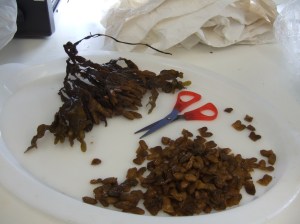
Cut receptacles of bladderwrack

Cut receptacles of bladderwrack

The picture to the left shows a bladderwrack ready to sow. Note that the pile of cut receptacles to the right in the photo is from three plants.

In order to separate between males and females, one has to cut a mm-thin slice of the receptacle and (with a little magnifying help from a loupe or similar) see if there are oogonia (8 eggs in a small sack) or antheridia (64 sperm in an even smaller sack). This can only be done on ripe receptacles, or else it is very hard to see.

Round oogonia contains 8 eggcells. Some are beginning to open up.

Round oogonia contains 8 eggcells. Some are beginning to open up.

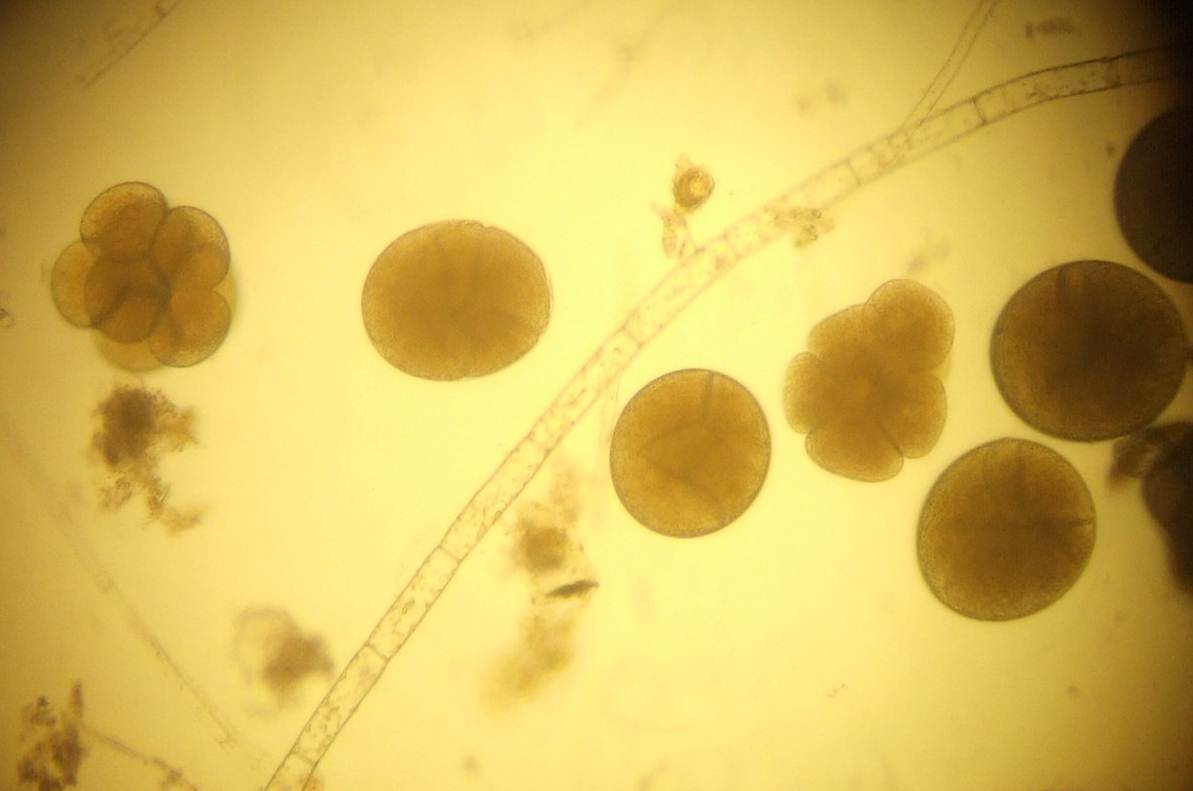
Each receptacle consists of several small chambers, conceptacles. The opening pore of these conceptacles are what causes the warty structure of the receptacle. Each conceptacle openes onto the receptacle surface, and this is where oogonia and antheridia (eggs and sperm in bags) are ejected out into the water mass during fertilization. When the oogonia and antheridia have reached the water, the bag keeping them contained, begins to dissolve.

The female oogonia looks like a collection of small green peas, and can be seen with the naked eye if they are very ripe.

It's a girl! Lots of ripe, round oogonia in the receptacles.
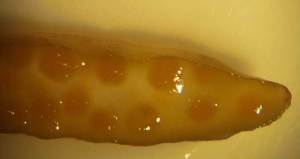
It’s a girl! Lots of ripe, round oogonia in the receptacles.


A ripe male, packed full of orange sperm.

A ripe male, packed full of orange sperm.

Antheridia are too small to see, even with a loupe. You need a microscope for them. On a receptacle cut, they give an impression of orange balls along the inside of the receptacle edge (see picture). The colour comes from the eyespot of the sperm, which is orange. With this, the sperm can tell light from dark.

Reproduction occurs around full moon, when it is much darker down towards the bottom than up towards the surface. The sperm “knows” that it should swim towards darkness. The reason for this is that the heavy eggs are sinking in order to attach to the bottom once they become fertilized.

Fucus evanescens

Fucus evanescens, is an introduced species to the Baltic Sea. That means that it did not enter the Baltic Sea by itself, but was brought here, possibly by humans. A piece of seaweed could easily have stuck to an anchor or similar. This is quite common nowadays, where boats unknowingly transport species in their ballast water from one place to another.

More information will follow.

Fucus serratus – Serrated wrack

Serrated wrack, Fucus serratus, is easily recognized by its serrated edges. In the Baltic Sea we can find serrated wrack along the Swedish coast up to the Gryt archipelago in Östergötland, where the salinity is approximately 7 psu. We have not found any observations of its distribution along any other Baltic countries coastlines. If you know of any such, please let us know.

Serrated wrack (Fucus serratus) on the Swedish coast

Serrated wrack (Fucus serratus) on the Swedish coast

Serrated wrack is sensitive to dehydration and is not as tolerant as i.e. bladderwrack to air exposure. Where we find baldderwrack and serrated wrack living together, the serrated wrack is often found slightly deeper thatn the bladderwrack. Outside the east coasts of Öland and Gotland, for example, there are wonderful forrests of serrated wrack at about 8 m depth.

Serrated wrack thrown ashore by waves often gets a more brown-orange colour before it dries and turns almost black.
In the winter, you can find frost covered seaweed when you walk along the shore.

Frozen Fucus serratus

Frozen Fucus serratus

More information will follow.

Fucus radicans – Narrow wrack

The scientific name of narrow wrack is Fucus radicans which means that it belongs in the Fucus family, together with bladderwrack, serrated wrack and spiral wrack (Fucus spiralis).

Narrow wrack is recently discovered, since it was long belived to be a dwarf morph of bladderwrack. It is not unusual that organisms are smaller in the low salinities of the Baltic Sea. Using genetic tools, narrow wrack was identified as a new species in 2005. Since then, researchers at Stockholm and Gothenburg University have studied the ecology, reproduction and genetics of the narrow wrack.

Narrow wrack (right) is thinner and more bushy than bladderwrack (left)

Narrow wrack (right) is thinner and more bushy than bladderwrack (left)

Narrow wrack is found along the Swedish coast from Öregrund to Umeå, from around Vaasa area down to Poori/Björneborg on the Finnish coast and around the Estonian island Ösel/Saaremaa (see map under The Baltic Sea fact). Narrow wrack has not been found outside the baltic Sea, as far as we know.

Narrow wrack is clonal, wich means that it reproduces by fragmentation, but it also has sexual reproduction. The individuals that have formed by fragmentation, where small branches from the plant falls off, drift away and then reattach to a rock or boulder, all have the same genetic variation as their “mother” plant. There is one plant in particular that have been very successful along the Swedish coast, where almost 80% of all individuals are one clone.